Some photographs don’t need much of an explanation. The above photo of Jimmie Nicol says everything; 300,000 people screaming to sitting alone in a matter of days.
On their last few hours together, the five Beatles headed back inside for their next interview with the waiting journalists. As with the first interview, the banter between John, Paul, George and Ringo was as funny as ever, with Ringo prominent throughout. It was as if Nicol was the invisible Beatle; Ringo was back and all was good, except for Jimmie Nicol. At one point, a reporter asks him about his plans while the other Beatles are still being interviewed. He is quickly shut down.
On reflection, Nicol was asked about how he was treated and how he felt sitting in for Ringo in the biggest group on the planet. “After Ringo returned, they changed. It was like welcoming a close member of the family back. They treated me with nothing but respect as a musician. And I think they thought I was very good. John once told me I was better than Ringo but that I just missed the ship. When I was on the plane back to London, I felt like a bastard child being sent back home from a family that didn’t want me. When you have had the best, you can’t accept anything else.”
Interview with Jimmie Nicol
Under Curfew
The Beatles were under curfew, instigated by Brian, and overseen by Derek Taylor and Mal Evans. However, it was Nicol’s last night in Australia, and he wasn’t going to abide by any curfew. After all, he had sneaked out before and had fun, going mostly unrecognised. This time, it was different. He had only been out for a short time when Taylor and Evans turned up at the bar, grabbed Nicol and took him back to the hotel. After all, he was still a Beatle! Everything had changed, because not only had Ringo arrived, but Brian Epstein as well. Nicol’s short career with The Beatles ended not in a blaze of glory, but a mild whimper.
Back Home – Hello, Goodbye
On 15th June 1964, Brian took Jimmie to the airport before he could even say goodbye to the Fab Four, who were still in bed. If ever there was a photograph that needed no caption, it was the one of Jimmie sitting all alone in a near empty airport with nobody paying any attention to him. How things had changed in just a matter of days. When asked about that photograph, and if he felt lonely, Nicol said: “That’s a beautiful picture. Well, if you look at that photograph, that answers your question.” (Evert Vermeer) No words were needed.
However, a TV reporter spotted him, and Nicol gave his final interview as a Beatle, reflecting on his exploits in Australia. He was asked, in a different way, the same question about what he would do next. “Well I hope to do something that I want to do. Now there might be a possibility that I might be able to do something….maybe earn enough money to study in America. That is what I want to do, is study drums in America and American music. And learn to arrange.” (The Beatle Who Vanished)
With Brian sitting nearby, the television interviewer brings him into shot to say an awkward ‘thank you’ on camera to Nicol. “I’d just like to say to you Jimmie that The Beatles and I are very, very grateful for everything you have done. You carried out a fine job for us and we’re very, very pleased. We hope you have a great trip back to London and every success to you in the future.” Jimmie’s response? “Thank you very much Brian.” It looked and sounded staged, broadcasting an obvious lack of emotion between the two men. In front of the camera, they were both professional, but Nicol, like so many people who featured in the story of The Beatles, had his part to play and then retired to virtual anonymity.
WHAT HAPPENED NEXT?
In his interview with Teutsch, Nicol reflected on his time with The Beatles.
T: “Did you ever see them after the tour?”
JN: “I had a band (The Shubdubs) and Brian put us on the same bill with The Beatles and the Fourmost one night (12 July 1964 at the Hippodrome Theatre in Brighton). Backstage, we talked, but the wind had changed since we last saw each other. They were pleasant.”
T: “Why do you think you were forgotten after all this?”
JN: “When the fans forget, they forget forever. After the Beatles thing was over for me, I played around for a few years then got away from the music scene. I mean, when you’ve played with the best, the rest is just, well, the rest.”
T: “Any regrets?”
JN: “None. Oh, after the money ran low, I thought of cashing in in some way to other. But the timing wasn’t right. And I didn’t want to step on The Beatles’ toes. They had been damn good for me and to me.”
SHUBDUBS, LIVERPOOL, SPOTNIKS, MEXICO………
When he returned home, he formed a band, The Shubdubs, who had a couple of singles, but not much success. He joined Swedish group The Spotniks, who had international hit albums and tours, when he ended up, after a disagreement, stranded in Mexico, where he stayed for a while, working on a number of projects, before coming out of hiding in 1984 in a Beatles Unlimited show in Holland. It was 20 years since Jimmie had played there with The Beatles. Nicol got up on stage with a local group, and promised a book would follow. It never did.
How did The Beatles remember Jimmie? His phrase on tour with them, when they asked how he was doing, replied; “Getting Better”, as commemorated in the Beatles song.
And Jimmie has disappeared. Jim Berkenstadt, author of The Beatle Who Vanished, is now taking Jimmie’s story to the big screen, which is some story; looking forward to that!
However, if you know where Jimmie Nicol is, let us all know please??????
The Fab Five – Jimmie Nicol, George, Ringo, Paul and John
Jimmie Nicol was the first Beatle to be called the “Fifth Beatle”, when he joined The Beatles at short notice, after Ringo fell ill on the eve of their world tour. George wanted to call it all off; that wasn’t possible. After a recommendation by Bobby Graham (the first drummer to turn Brian down as replacement for Pete Best), Jimmie soon joined up with John, Paul and George.
Until a few years ago, there was not much known about Nicol, until Jim Berkenstadt’s book, “The Beatle Who Vanished“, was published. An incredible piece of research by the Rock ‘n’ Roll Detective.
How Jimmie Nicol joined The Beatles
The Daily Mail covered the story on 4th June 1964. Under the banner “Ringo Is Replaced”, they revealed the truth behind the headline. Nicol “told reporter Robert Bickford, ‘I’m knocked out man. It’s quite a laugh being one of The Beatles. I can handle the job okay. Ringo can swing all right, but I’ve got more range.” The newspaper was keen to support Nicol’s addition to the tour: “An expert drummer, he is highly regarded by the record industry and was at home in Barnes, Middlesex, when The Beatles’ recording manager George Martin phoned and asked him to go straight to the EMI studios where the other three band members were recording.
After a two-hour rehearsal, John Lennon told him: ‘You’re in. This should be worth a couple of quid to you.’” The journalist also spoke to Ringo in the hospital to see how he was feeling. ”I’m not too bad really”, he said. “I feel pretty groggy but I am sure I’ll be well enough to go with the boys on Sunday to Hong Kong. It’s pretty nice in here. I’m surrounded by hot water bottles but I am still shivering. It’s a terrible drag not being able to go with the boys to Europe.”
This enigmatic drummer hit the heights that only the Fab Four had experienced, but it was over quickly. With exclusive photographs from the tour, and interviews with fans who attended the concerts and members of the support groups in Denmark and the Netherlands, and promoters too.
Top Six Records
With his battered Trixon drum set feeling its age, Nicol felt it was time for another upgrade: a shiny blue Trixon Luxus kit with a crocodile-style design. Nicol worked closely with Johnny Harris, trumpet player with the band, and the two became good friends. Their relationship would be especially important to Jimmie’s career when Harris was offered the position of Producer/Arranger at Pye Records, where he developed a great reputation and came to the attention of an Australian executive from Top Six Records.
Bill Wellings had this idea to put out an EP of cover versions of the top six chart hits, offered at a cheap price so those music fans who wanted the latest songs, but couldn’t afford the real artists, could have a version of six songs for the price of one. When Wellings approached Johnny Harris to arrange the songs, he knew which drummer was experienced and versatile enough to do the job: Jimmie Nicol. As well as being a great drummer, Nicol could also read music, which was a tremendous advantage to Harris who had to record lots of songs on a tight budget, and with a quick turnaround time. This was 1964, and which band was on top of the charts? The Beatles, of course. It was this twist of fate that would, within a few months, help to earn Nicol the biggest job on the planet.
Jimmie Nicol and Beatle Mania
In January 1964, Top Six released an EP entitled “Beatle Mania Special” using the phrase coined in October 1963 to describe the fans’ love of The Beatles. This record, which featured “She Loves You”, “Twist and Shout”, “Please Please Me”, “I Wanna Hold Your Hand”, “From Me To You” and “Love Me Do”. Incredibly, this record sold 100,000 copies. Nicol was now a successful recording artist and session drummer whose skills would be required very soon. In February 1964, as The Beatles were heading off to conquer America on The Ed Sullivan Show, Nicol was asked to form his own band and release a single, arranged by Johnny Harris. Jimmie Nicol and the Shubdubs released a ska version of the old nursery rhyme “Humpty Dumpty” on Pye Records.
DENMARK – COPING IN COPENHAGEN: 4th June 1964
On Thursday, 4th June 1964, John, Paul, George and Jimmie headed to London Heathrow Airport with their chauffeur Bill at the wheel of their Austin Princess car. They were allowed to board the aircraft before the other passengers and, of course, were asked for autographs by the crew. The co-pilot, who had probably been asked by his daughter to get their autographs, mistook Paul for Ringo – who wasn’t even on the plane! George, spotting the chance for a laugh, urged Paul to sign. “Go on, Ringo”, he told Paul, “Give him your signature”.
With exclusive photographs from the tour, and interviews with fans who attended the concerts and members of the support groups in Denmark and the Netherlands, and promoters like DJ Ray Cordeiro in Hong Kong.
But Australia was where Ringo caught up with his fellow Beatles.
On 13th June, DJ Bob Rodgers interviewed The Beatles and quizzed Nicol about his adventures with the band and the fact that his final appearance with them was that very evening.
BR: “Jimmie, you’ve got your final performances tonight and then Ringo arrives tomorrow.”
JN: “Yes, that’s right. I’m looking forward to meeting him.”
BR: “And then it’s all over for you. What’s going to happen? I hear you may not be going back to England?”
JN: “Not for a little while, no. I fancy going back to Sydney.”
That didn’t happen.
Sunday 14th June 1964 was a strange day, because, with a recovered Ringo now in Australia, there were five Beatles to be interviewed in Sydney Airport. However, the focus was now on Ringo, not Jimmie, as the interview bounced back and forth among the four of them. Eventually, Nicol was predictably asked about life after The Beatles. He confirmed that he wanted to remain in Australia, but with no firm offer, nothing was certain. As the questioning returned to the reunited quartet, the limelight was beginning to fade on Jimmie.
In May 2004 I was fortunate enough to spend a couple of hours with Alistair Taylor on a trip from his home in Matlock, Derbyshire to Liverpool. Alistair was known as The Beatles ‘Mr. Fix-it’ and was a vital cog in the day-to-day operation of NEMS Enterprises. He was Brian Epstein‘s P.A. and the man to whom John, Paul, George and Ringo turned if they needed anything.
As we collected him, he said that he was tired and that we weren’t to be offended if he dropped off to sleep on the journey. Yes right, Alistair!
Alistair taylor and the beatles
For the next two hours I enjoyed the company of one of the nicest men you could hope to meet. He was great fun, entertaining, and yet humble and full of stories. Alistair didn’t see the need to talk up his part in The Beatles’ story, something he has been accused of. He spoke lovingly of his wife Lesley who had been diagnosed with terminal cancer, and their long and happy marriage. Sadly, within a matter of weeks, Alistair passed away, and was soon followed by his beloved Lesley.
Alistair was born in Runcorn, Cheshire, to the south of Liverpool, on 21 June 1935. After a brief spell in London, where he met Lesley, he returned north to work for a timber merchant, William Evans in Widnes, though this didn’t satisfy him.
So Alistair, how did you come to work for Brian epstein?
“I saw an advert in the local paper for a Sales Assistant in NEMS, ‘apply to Brian Epstein’. Naturally, I quickly answered the ad. When I met Brian, we got on really well and talked about all aspects of music. My love was always for jazz, which was different to Brian who loved classical music. At the end of the interview, which lasted for two hours, Brian said I was over-qualified for the position that was advertised and he couldn’t pay me enough for the position on offer. My heart sank.
But then he said he wanted to employ me as his personal assistant, for £10 per week. I didn’t really understand what he wanted, but of course I said yes! It was the beginning of a great relationship with Brian, which had its highs and lows. He sacked me four times, and I resigned a couple of times too!
Brian was gay. I knew that. He knew that I knew that, and it didn’t matter. He knew I wasn’t gay, and was happily married. It never interfered in our business relationship.”
Alistair’s voice suddenly became more serious.
“I loved him”
“At this point, I want to say something that has been edited out of interviews in the past. I loved Brian. It doesn’t have to be complicated by homosexual overtones. It wasn’t like that. I loved him. He was awkward, irritating, annoying and frustrating, but I loved him. Full stop.
Once I had started working there, Brian and I had a little bet on each big record coming out. We would have to say if it was going to be a hit or not. Needless to say, even though he didn’t like pop music, he could hear a hit a mile away. I rarely got it right; I can’t remember him getting it wrong, ever! The bet was only a G & T (Gin and Tonic) but he was incredible.
He introduced this remarkable system of record ordering with these little tags so that we knew when we had to re-order. In the end, if Brian put in a large order for a particular record, the other retailers would order them too. Brian was that impressive, and his opinion was often sought.”
What about Raymond Jones, Alistair?
“I was Raymond Jones. Kids were coming into the shop and asking for this record ‘My Bonnie’ by The Beatles. We didn’t have it and, until somebody put in an actual order, Brian wouldn’t do anything. You see, Brian had this claim that if you ordered a record by anyone, anywhere, he would find it. However, no matter how many people asked for it, nobody had ordered it by paying a deposit. Particularly as this was a German import, this was even more important.
I knew we would sell lots of copies, so I made out the order form and paid the deposit from my own pocket in the name of Raymond Jones, one of our regular customers.
“My bonnie” by the beatles?
Now we had an order, Brian and I set about tracking it down. Of course, it was recorded in Germany, and was recorded under the name of Tony Sheridan and the Beat Brothers. Brian ordered the first batch and they sold out in no time at all.
So, a few years ago, I announced that I was Raymond Jones. And that is it, it was me.”
the real Raymond jones?
How does this fit? Local radio presenter and writer Spencer Leigh tracked down the real Raymond Jones a few years ago. Bob Wooler even had an address for him at 48, Stonefield Road, Liverpool. Therefore, there was also a local lad called Raymond Jones, who asked Brian Epstein for the record and told him, when asked, who The Beatles were and where they were playing. But what about Alistair’s tale?
Well, we know that Raymond Jones came into the shop and talked to Brian about The Beatles and the record, but maybe did not place the order and paying the deposit required before Brian would track it down. Therefore, Alistair told me that he simply used the real Raymond Jones’ details for the order, and paid the deposit himself. Not the normal practice but, as this was a German import, taking a deposit was the standard for NEMS.
Whatever the motive, in this small way Alistair became ‘Raymond Jones’ but the real Raymond Jones remains an integral part of the story.
brian and Alistair visit the cavern
Of course, the big event was the trip to The Cavern on 9 November 1961. What exactly happened?
“Brian wanted to go and see The Beatles who were so popular. Everyone was talking about them and we had sold so many copies of the record. Brian didn’t know where The Cavern was, which of course I did as I had been there when it was a jazz club. He was amazed to realize how close it was.
the beatles were loud, awful, and not that good
“We went down into the cellar, and that smell of rotting fruit and vegetables never left The Cavern. It was smelly and horrible, and Brian and I looked out of place in our smart suits. We sat at the back and watched while the place went mad for these scruffy musicians. The noise was terrible. They were loud, awful, unprofessional, scruffy and frankly not that good. But we both couldn’t help tapping our feet to the rhythm. They had something. Don’t ask me what it was, because I don’t know. If I did I would have been a rich man. I call it ingredient ‘X’.
“They played five songs I think, but the one that made us stop and take notice was when they introduced a song of their own called ‘Hello Little Girl’, which The Fourmost later recorded. It wasn’t just that they were prepared to play their own song but that it went down well. Maybe that is what Brian saw in them.
“Anyway, we left and went to the Peacock Restaurant as planned, and that is where Brian dropped the bombshell. He asked me ‘Who do you work for? Me or NEMS? What would you say to me managing The Beatles?’ I was a little lost for words.
the biggest mistake
“Brian was a man who was bored easily, and The Beatles came along at the right time. He then made me the offer, which could have made me a wealthy man. He offered me a percentage of The Beatles, there and then. I couldn’t contribute anything financially, so I said I couldn’t accept his offer. Brian understood but asked me if I would work for him in managing The Beatles. Of course I would. I would have done anything for him. And so that is where it all began. It was the biggest financial mistake of my life, but you can’t change things”.
How did you get this title of The Beatles’ ‘Mr. Fix-it’?
“Whatever The Beatles wanted, I fixed it for them. I was Brian’s general manager, so I stayed at home while the boys went on tour, because I looked after all the artists for Brian, not just The Beatles. Later on, I sorted out cars, houses, trains and planes and even buying an island. Whenever they went on tour, I made the arrangements. I loved it; it was great fun. I was there when they signed their management contract with Brian, which, of course, Epstein didn’t sign. I signed as witness, but Brian wouldn’t; in my opinion, I think he wanted a way for The Beatles to get out of it if it didn’t work out. He was an honourable man, and was stepping out into a new world. If it did go wrong, he didn’t want them tied into a long, complicated contract. That’s what he was like.
“They just went along the line and signed, and then I did. I remember Paul saying something like, ‘We’re going to be stars, but if we don’t make it together, I’m going to be a star’. That was Paul for you”.
What do you remember about the beatles in Liverpool?
“They were always hanging around the shop. I remember John and Paul coming into NEMS and asking if they could borrow a typist, called Barbara I think. They brought song lyrics in on scraps of paper—once it was on toilet paper—and she typed them up and then threw the scraps in the bin. Imagine what they would be worth now”.
the beatles; scandals, girls
So Alistair, with their fame bringing untold riches, and the pick of the girls, surely there must have been scandals and claims?
“The Beatles had managed to get into trouble with local girls, and most of the girls who were pregnant were looked after by Brian. I often had to be the one to hand out the cheques. It is true that many of these girls could have come forward and destroyed the image that The Beatles had tried so hard to portray, but they were willing to settle without undue publicity”.
George harrison: “I’m no longer a beatle”
We started to discuss the time when he thought The Beatles had had enough of touring. Most people know that after their last concert in 1966, George famously said that he was no longer a Beatle. But to my amazement, Alistair recalled a much earlier conversation.
“George told me back in 1963 that he was already starting to have second thoughts about fame”.
He recalled an incident when The Beatles were flying to London from Liverpool Airport, but George hadn’t turned up. The others went to London, leaving Alistair to contact George.
“I rang him at home to find out what was going on. George said, ‘I don’t want to be a Beatle’. In a panic, I went round to talk to him and George said he didn’t like all the pressure and the frenzy of the crowds and the fans. Thankfully, he came to his senses and the matter was never discussed again until they finished touring in 1966”.
Brian was determined to get the beatles a record deal, wasn’t he?
“Oh yes. I remember seeing him at his desk crying. In the end, he virtually resorted to blackmail. NEMS was the biggest record retailer around, and so he threatened to withdraw his business”.
Was NEMS that big? How does that work?
“He could buy his records through a different company, like Decca. It was only anything on HMV (His Masters Voice) that he had to buy from EMI direct, and that wasn’t a big concern. The rest of the records he could get elsewhere, so that was a lot of business to them. I believe it was only this that made them do something. Of course, they just fobbed him off on to George Martin who was looking after comedy records, but at least it was something”.
It all went ‘pear-shaped’ at Apple, didn’t it?
“I was the face of Apple for the advertising. McCartney asked me to pose as a oneman band in the newspapers to get people to send in their tapes for consideration. Then everyone sent stuff in and it all quickly went mad. Money was being wasted and I could see it. People were leeching off them—it was a disaster.
“The end was no great surprise to me. I was out at a business lunch when I received a phone call from the office. They told to come straight back. I told them I couldn’t as I was in a business meeting. The message was, ‘come back now’. I had a feeling what was going on. I made it back to Peter Brown’s office. He basically told me that I was out and I had the afternoon to clear my desk.
There was Allen Klein’s hit list and I was number one on the list—I saw it. I went home and Lesley knew straight away there was something wrong. She even guessed that I’d lost my job. I wanted to get in touch with the lads, not to beg for my job back—I had too much pride for that—but to see if they knew what was happening. I rang them all—one of them I know was in the background when I called—but they wouldn’t speak to me. That hurt me.
After all I’d done, they couldn’t and wouldn’t speak to me. I was closest to Paul, spending time at his house more than the others, because he was still living in London.
the beatles; “hello, goodbye”
The whole ‘Hello, Goodbye’ thing happened at Paul’s house. I was round there one night and I asked him how he wrote songs. We sat at his piano and he said, ‘I’ll say one thing, you say the opposite’ so we went black, white, yes, no, hello, goodbye. Not long after, the song ‘Hello, Goodbye’ was written, so I like to think of that as my little contribution”.
Alistair was done with The Beatles and, to their shame, he was left to eek out a living washing dishes in a little Bed & Breakfast in Derbyshire. He could have had millions thanks to Brian, but turned his opportunity down. When he was sacked from Apple, they could have looked after him, but they didn’t.
Alistair and I had a great journey together and he gave me his phone number to follow up. He gave an interview to Fulcrum TV and then sadly, a few weeks later he died quite suddenly. He had seen so much and been so close to The Beatles’ inner circle, and yet had been let down by them.
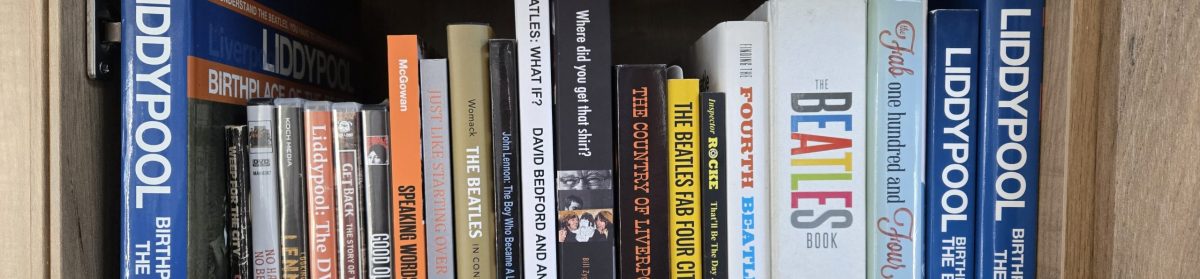
Liddypool: Birthplace of The Beatles by David Bedford
However, being the gentleman that he was, he didn’t bear any grudges against them, but rather talked fondly of them.
It was great to meet you Alistair—hello and goodbye.
The story of the 23 drummers who put the beat in The Beatles
Finding the Fourth Beatle
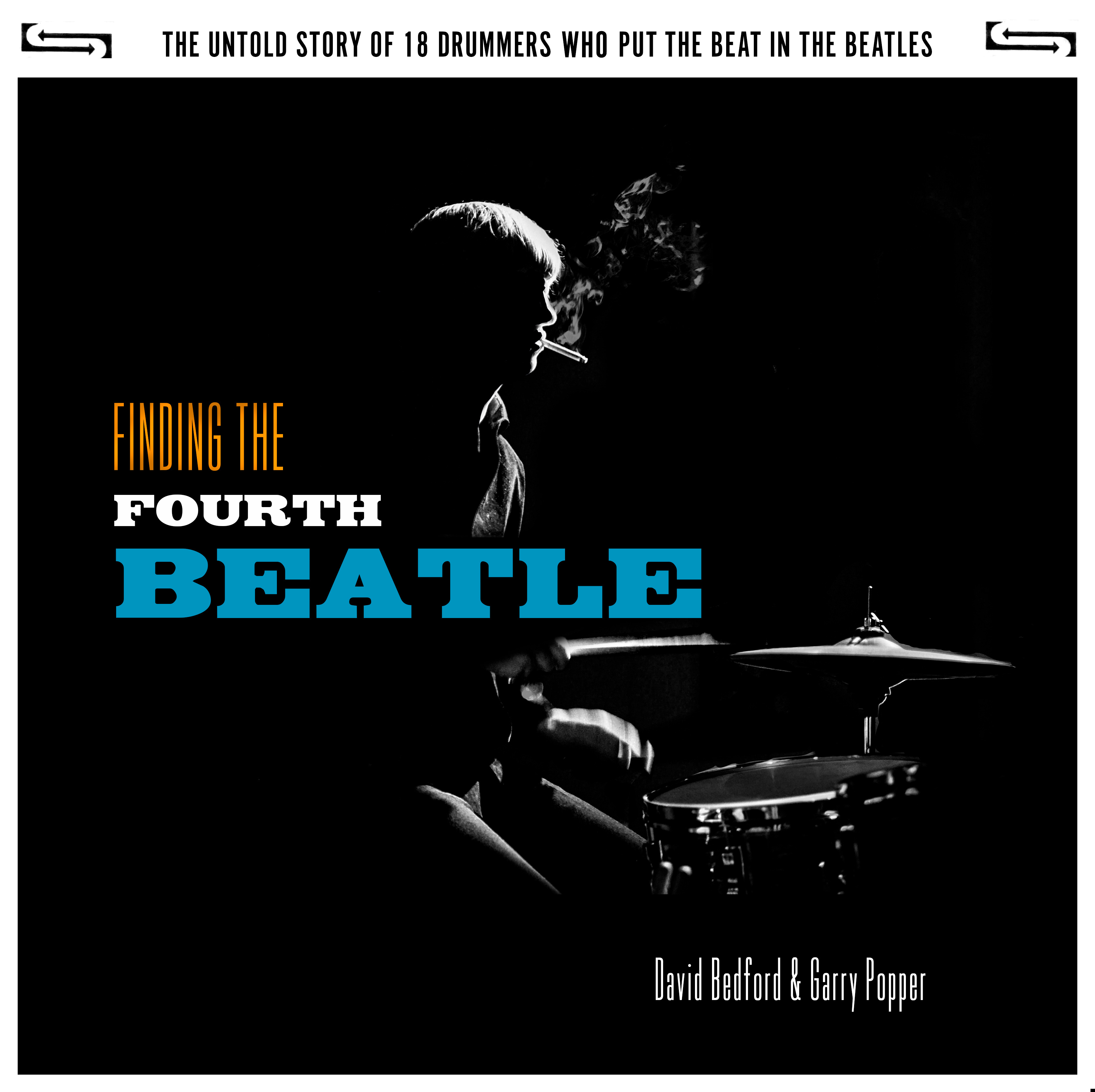
Finding the Fourth Beatle: for the first time… ..the Complete Chronicle of the ‘forgotten’ Beatles’ who played their part in the long quest for a drummer.
“They’d had a succession of drummers through the years and finally found one who integrated, someone who fitted. Until this point it was always John, Paul, George … and a drummer…” Neil Aspinall. Former CEO of Apple and the Beatles first road manager
The fourth Beatle to join was Ringo, right? Wrong! How about John, Paul, George and Norman? Or John, Paul, George and Tommy…or Johnny…or Terry? Or even Ronnie the Ted! Ronnie the who? Exactly!
Ringo Starr wasn’t the fourth Beatle to join. He wasn’t even the last! Half a century and hundreds of books after the Beatles went their separate ways, “Finding The Fourth Beatle” has finally pieced together the untold story of the Fab Three’s long quest for a permanent drummer – and how close the problem came to ending their dreams on several occasions, including those of their manager, Brian Epstein!
Thanks to their unrivalled network of sources Liverpool author’s David Bedford and Garry Popper have produced an in-depth investigation into the origins of the Fab Ones themselves, too. As a result “Finding The Fourth Beatle” reads like a thriller, mapping each crisis in the Beatles struggle for fame and fortune. It’s a roller-coaster story that tells it like it really was – a long and winding road paved by ruthless ambition and farce – none more vividly detailed than the panicked conspiracy to dump drummer Pete Best; one of darkest and longest controversies to engulf the band.
Book Highlights
Highlights include: Why Pete Best was not fired/sacked PLUS Those drummers who were almost the “Fourth Beatle”, and those who weren’t In-depth analysis of the failed Decca audition, and EMI sessions in 1962 PLUS why Brian Epstein didn’t sign the first Beatles contract How Ringo Starr joined The Beatles – and who else was asked before him A previously unknown Beatles contract The vindication of Pete Best and a celebration of Ringo Starr
“The must-read Beatles book of the year. A masterwork of rock ’n’ roll sleuthing and good old-fashioned research.” Kenneth Womack, author of Maximum Volume: The Life of Beatles Producer George Martin (The Early Years, 1926-1966)
“This is the work of responsible researchers who challenge the usual received wisdom, carefully presenting their findings on a rock-solid foundation of fact.” Robert Rodriguez, award-winning Beatles author and creator of the Something About The Beatles podcast
Beatles first manager Allan Williams with David Bedford
David grew up in the Dingle, Liverpool, near the bottom of the street, Madryn Street, where Ringo Starr was born. He later attended St. Silas School, the same primary school that Ringo Starr, Billy Fury and Alf Lennon (John’s father).
He and his wife, Alix, moved to live near Penny Lane, where they have lived for the last 30 years. Their three daughters were born in Oxford Street Maternity Hospital, where John Lennon has been born. The three girls all attended Dovedale School, the same school that John Lennon and George Harrison attended. David had been the Chair of Governors there for nearly 20 years.
When illness forced him to retire at the age of 35, encouraged by his doctor, he began to read, research and write about The Beatles for the London Beatles Fan Club magazine, and helped to found the British Beatles Fan Club. Realising that so many stories about The Beatles and Liverpool were incorrect, he set out to dispel the myths by interviewing the people who knew The Beatles best.
The Fab one hundred and Four: The Evolution of The Beatles
The Fab one Hundred and Four
His second book, the follow-up to “Liddypool”, “The Fab one hundred and four: The Evolution of The Beatles” was published in 2013 to further critical acclaim, with original interviews and rewriting Beatles history, by telling of the 104 people who contributed to the early history of The Beatles.
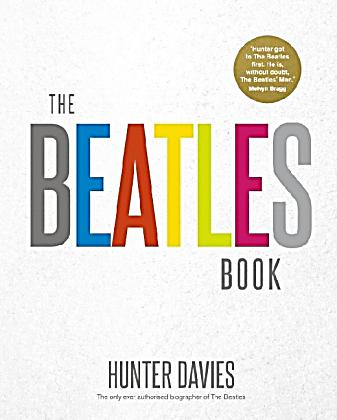
The Beatles Book
The Beatles Book
In 2016, he published a book with original Beatles biographer Hunter Davies, plus Spencer Leigh and Keith Badman, called “The Beatles Book”.
Inspector Rocke: That’ll Be The Day That I Die
As an aside from his Beatles books, David wrote a crime fiction novel in 2017 around a fictional Liverpool detective called Inspector Rocke. Each story is set around a key moment in Beatles history, and features The Beatles themselves, though not as suspects!
Looking for Lennon
In 2018, he was the Associate Producer and Historian for the documentary feature film “Looking for Lennon”, which was nominated for a National Film Award.
Finding the Fourth Beatle
Finding the Fourth Beatle
In 2018, he also published his third book, with co-author Garry Popper, called “Finding the Fourth Beatle“, about the 23 drummers who put the beat in The Beatles.
He has several other book projects, and much more, on the go.
For the first time, the country music roots of The Beatles are covered in detail, telling how Liverpool had the biggest Country and Western scene in the UK – and probably in Europe – in the 1940s, ‘50s and ‘60s. This influenced The Quarrymen and, of course, The Beatles.
The Beatles: What If?
The Beatles: What If?
IN 2025, David published his latest book, The Beatles: What If?, written with his friend Andrew Phillips.
They have looked at 70 key moments in Beatles history, where if something had changed, Beatles history could have worked out differently.
What if Ivan Vaughan hadn’t been friends with both John and Paul?
What if The Beatles passed the audition at Decca?
What if they didn’t meet Brian Epstein?
These and many more are examined, and their potential affect on Beatles history is discussed. But will you agree?
David was the Archive Producer/ Historian for the documentary film, No Hamburg, No Beatles, about The Beatles story in Hamburg. featuring rare archive and photos, together with interviews, this is the definitive story of The Beatles apprenticeship in the clubs of Hamburg.
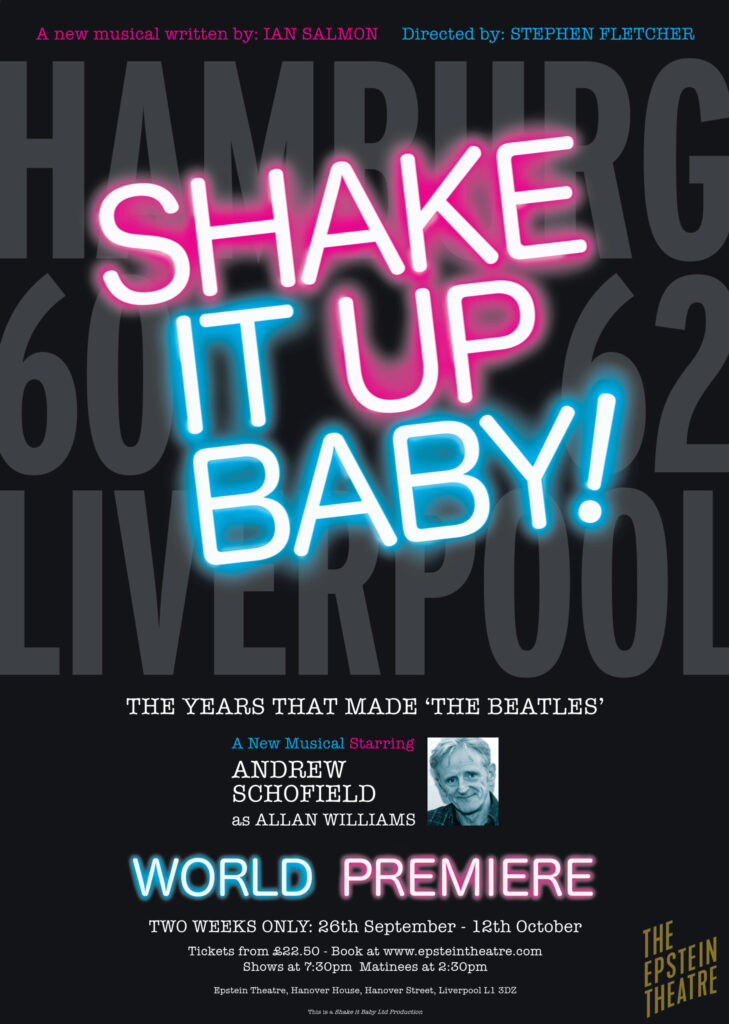
Shake It Up Baby!
David was the Script Advisor/ Historian for this play written by Ian Salmon and Directed by Stephen Fletcher. It had its premiere in Liverpool at the Epstein Theatre in September 2025.
The Beatles: Paul McCartney, George Harrison, John Lennon and Ringo Starr
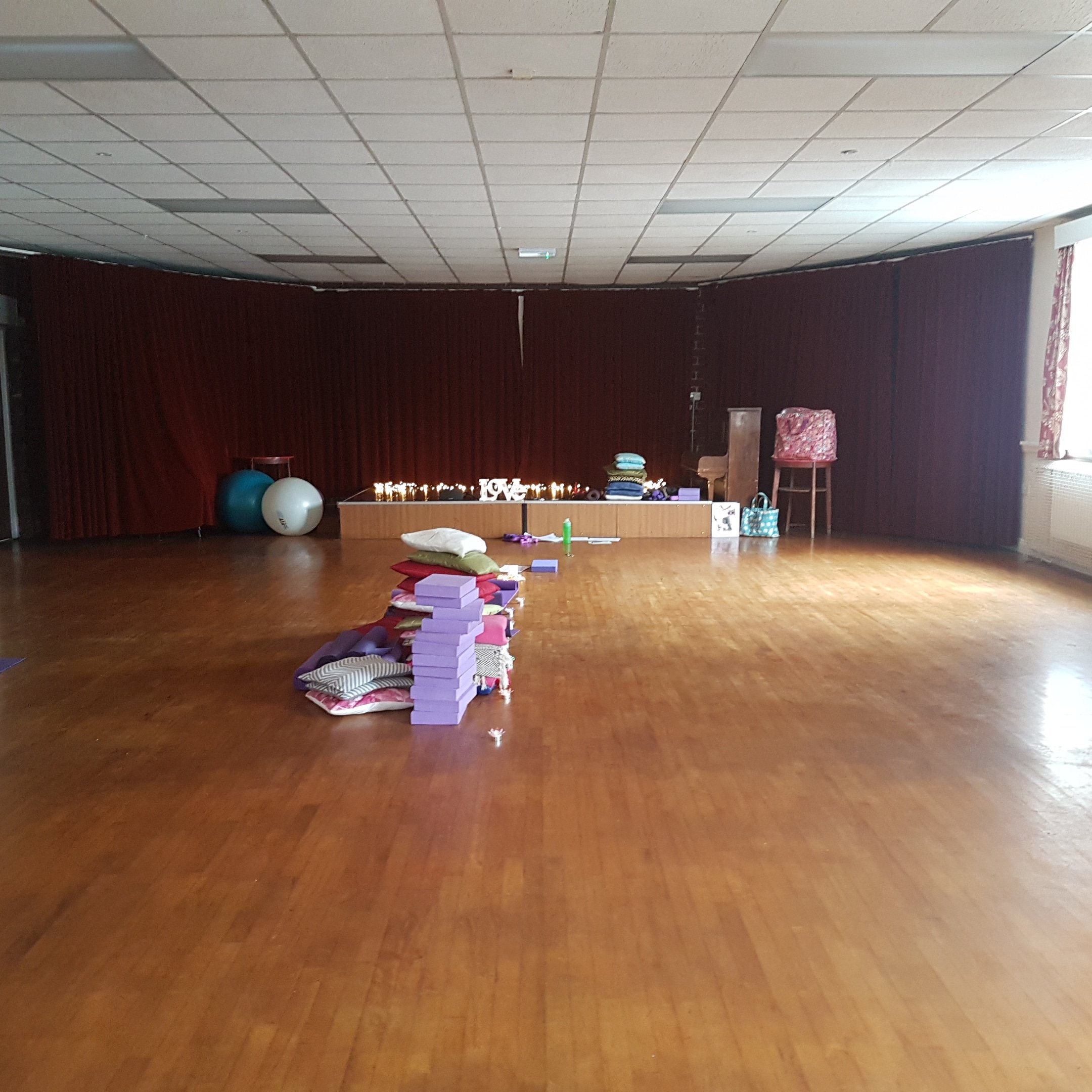
In this little hall on 7th September 1962, in between The Beatles two EMI sessions on 4th September and 11th September, John, Paul, George and Ringo played here at Irby Village Hall on the Wirral. Although the hall was packed, they hadn’t raised enough money to pay Brian Epstein, who had to return for the balance of the money.
George Harrison’s forgotten suitcase
George Harrison also left a suitcase behind, full of guitar strings and those bits and bobs of electrical gear. George never collected it. How quickly their world changed from here. Only 15 months later, they were appearing before over 70 million Americans on the Ed Sullivan Show. They earned their success.
From this photograph, you can see that it wouldn’t hold that many people. Irby Village Hall is one of over 100 local venues featured in Liddypool, my first book.
John, Paul, George and Mahapurush? Sound familiar?
Well, it happened, and the full story is in “Finding the Fourth Beatle” – not long now to reserve your limited edition copy of the new book that is rewriting Beatles history. Mahapurush is only 1 of the 22 drummers featured in the book. Can you count 22 drummers? If not, you need this book! Finding the Fourth Beatle
When Ringo recorded “Elizabeth Reigns” on his Ringo Rama album (2003), he signed off by saying; “there goes the knighthood”. Some of his lyrics were not overly complimentary to her majesty, like:
“We don’t really need a king. Six hundred servants Use her detergent Scrubbing the palace floor
And all of your sins are As big as the Windsors So let’s point our fingers No more.”
Has that delayed his knighthood? Does he even deserve one?
Many have questioned: “why has he got it?” or “just because he was a Beatle?”. “Is this just further degrading the honour system?”
So what has Ringo done to deserve it? Many people, including Beatles fans, don’t give Ringo the credit for his part in The Beatles’ success. Was he just a lucky guy who jumped on the bandwagon, or something more? In our new book, “Finding the Fourth Beatle”, we examine how and why Ringo became the drummer in the Fab Four, the only drummer to have lasted the distance with John, Paul and George. From 1956-1970, we detail the 18 drummers who played a part in their success, and ultimately why Ringo became the right drummer at the right time. He wasn’t the first drummer asked to replace Pete Best, but he proved to be a wise choice.
But we aren’t just saying it without backing it up with evidence. We have enlisted the help of several drummers who explain what it was that made Ringo such a unique drummer, by analysing his style and his experience of playing skiffle, country, jazz, and to the audiences in summer camps at Butlins. We have had a number of Beatles songs analysed, and show his contribution, what difference he did make to those songs, and the evolution of The Beatles’ sound. He wasn’t just a spare part sat at the back of the band, but integral to their development as a group, who has gone on to be recognised as one of the most influential drummers of all time. Not bad for a boy from the Dingle!
But that, in itself, isn’t enough to warrant a knighthood. What else has he done? His well-known problems with alcohol led him, and his second wife Barbara Bach, to check in to rehab to battle alcoholism. Ringo emerged as a new man, and together with Barbara, the two established the Lotus Foundation:
“The objectives of the Lotus Foundation are to fund, support, participate in and promote charitable projects aimed at advancing social welfare in diverse areas including, but not limited to:
Substance abuse
Cerebral palsy
Brain tumours
Cancer
Battered women and their children
Homelessness
Animals in need”
Over the years, he has raised millions of pounds for his charity through books, performances, and most recently by selling off property and memorabilia he no longer needs/ uses. Through his high-profile status as a former Beatle, and successful solo artist, he has made a difference to countless lives around the world, much of which goes on unnoticed.
You don’t get a knighthood for being a Beatle: you do for making a difference and promoting Peace and Love.
Arise, Sir Fourth Beatle Ringo (and don’t mention “Elizabeth Reigns”!)
David Bedford Pre-order “Finding the Fourth Beatle” now
On Pete Best’s 76th birthday, Pete is probably the most controversial person in Beatles history, who divides opinions. Was he a good drummer? Why did the Beatles get rid of him? When we began work on “Finding the Fourth Beatle”, we realised we had to address these questions and reach an objective conclusion, and it has been one of the most interesting, and controversial investigations we have ever undertaken. There is so much invested in urban myth and opinion that reaching the truth is never easy.
However, what we have been able to prove is that Pete Best was never sacked! We have evidence, and I interviewed Brian Epstein’s lawyer who explained what really happened in that meeting at NEMS, and why Pete was not sacked.
We have also enlisted the help of 9 drummers to analyse Pete and Ringo’s drumming, especially the Decca audition, EMI audition and those first visits to Abbey Road in September 1962.
That way, we will have independent, objective analysis. After all, you can’t take the word of an author who isn’t a drummer, can you?
David Bedford Pre-Order your copy now
The film was a huge disappointment to me. Some nice footage, and bits of commentary from Paul and Ringo, but this was not a film for serious die-hard Beatles fans.
When we were told a couple of years ago that The Beatles were going to be captured in a new, fresh, exciting film, directed by the legendary director Ron Howard, there was great excitement among Beatles fans.
We were promised new footage, new photos, behind the scenes interviews and the first truly new Beatles film since the 1960s.
I attended the world premiere in Liverpool – we were screening 30 minutes ahead of London – and I walked the “blue jay way” carpet with Allan Williams, The Quarrymen, Julia Baird and many more, which was an honour. In the cinema, when we watched interviews with Allan and Beryl Williams, Joe Flannery, Freda Kelly and other Liverpool people, I was so pleased that the film started with the Beatles in Liverpool.
However, when that finished after 20 minutes, I realised something was not quite as it seemed. This film was only for us in Liverpool. Ron Howard, Paul McCartney and Ringo Starr appeared on the screens with a special intro for us, where Ron Howard aditted he hadn’t been to Liverpool but he would like to. Seriously? But then as Liverpool wasn’t to feature in the main film, I suppose it didn’t matter. Where were The Beatles from? Ermmm. Where were The Quarrymen? Stuart Sutcliffe? Pete Best, who probably played more hours live with The Beatles than Ringo, but no mention.
The film was a huge disappointment to me. Some nice footage, and bits of commentary from Paul and Ringo, but this was not a film for serious die-hard Beatles fans, but a nice trip through the Beatles touring years. The one thing it did show well was how fed up with touring the Beatles were by 1966. That was about it. There was nothing particularly new, and plenty I’d seen elsewhere and so much more they could have included, but didn’t.
There was no new insight into touring with The Beatles, and, as a Liverpudlian, this film was definitely made for the American market. Even when a clip was shown of The Beatles on the balcony in Liverpool in July 1964, there was no caption to tell you where it was, even though virtually everywhere else was captioned. When they showed The Beatles in Amsterdam in June 1964, there was Jimmie Nicol standing in for Ringo, but he was not name-checked or identified and just passed over to when Ringo rejoined the tour.
Oh, and I nearly forgot. The people they interviewed. Not ordinary fans, but they rolled out celebrities! Of course, the famous “Fifth Beatles” Richard Curtis, Eddie Izzard, Jon Savage, Whoopi Goldberg, Sigourney Weaver…………………Yes, right.
I could go on, because there were so many disappointments there’s not enough space! This was a huge opportunity missed.
Would I pay to see it again? No.
Would I recommend it to others? No.
Will I buy it on DVD? Probably not.
Was I disappointed? Definitely.
I ain’t got nothing but disappointment, babe, Eight Days A Week.
David Bedford





 In our new book, “Finding the Fourth Beatle”, we examine how and why Ringo became the drummer in the Fab Four, the only drummer to have lasted the distance with John, Paul and George. From 1956-1970, we detail the 18 drummers who played a part in their success, and ultimately why Ringo became the right drummer at the right time. He wasn’t the first drummer asked to replace Pete Best, but he proved to be a wise choice.