9th February 1964 – The Beatles on Ed Sullivan
16th April 1964 – Norman Smith drums with The Beatles
9th February 1964 – The Beatles on Ed Sullivan
16th April 1964 – Norman Smith drums with The Beatles

On 10th July 1964, The Beatles arrived in Liverpool for a civic reception at Liverpool’s Town Hall, as well as holding the Northern Premiere of A Hard Day’s Night. The image of them standing on the balcony was so iconic, I decided it should grace the cover of my first book “Liddypool: Birthplace of The Beatles“, published in 2009.
The reception was difficult to arrange, but Brian was determined to make it happen. His letter explained it:
“Thank you very much for your charming letter of the 4th instant. As you
probably know the boys and I set forth for the United States tomorrow morning. On their return the boys have an intense filming schedule, which will take them up to the end of April. They will then be resting for most of the month of May. So therefore while I look forward very much to accepting your kind invitation, for which the boys and I are most appreciative, I think the actual date may have to be left in abeyance for the present. With many thanks and best wishes.
Yours respectfully,
Brian Epstein
On the flight home their thoughts were occupied with this visit to Liverpool. One of the travelling journalists who had accompanied the group down under was from the Liverpool Daily Post and Echo, named, ironically, George Harrison—no relation whatsoever. Harrison’s observation was astute: “Probably for the first time in their show-biz lives our world-famed troubadours are nervous. They aren’t sure how their fellow citizens will react to this home-coming triumph. The four boys are thrilled to their fringes at the honour Liverpool is bestowing upon them. But in the back of their mind is a niggling doubt”.
Harrison spoke to each of The Beatles about how they were feeling as they came closer to their return to Liverpool. Even though all the preparations had been made, Paul McCartney didn’t know if it would click with Liverpool people. “I can’t somehow see all the kids I used to go to school with from Mather Avenue and their parents, turning out to watch young Paul McCartney drive by in a big car, along the road where we used to play together. I don’t think I’d bother to go and cheer for somebody else”, McCartney said honestly, “and I’ve got a feeling that they won’t do it for us either.
“And who is going to stand outside the Town Hall just to see us arrive? Only a couple of years back hardly anybody in Liverpool had heard of us. Now this! I’m keeping my fingers crossed and hoping that everything comes off all right, but I have butterflies in my tummy over it”.
Harrison (the reporter) observed that the manner of The Beatles was one of humility and that “there still isn’t a big head among the four of them. They just can’t believe they are important”.
John Lennon, never normally short of words, could hardly explain how he felt about the forthcoming event. “The only time I’ve ever been at the Town Hall was when they sent me from art school to draw it. Going back like this, in state, or whatever they call it, is a bit scary”. Ringo, however, was more forthcoming. “It’s a funny feeling. Makes you feel small and yet ten feet tall. I mean, all those other places in Australia and New Zealand where we went to civic receptions, they were only parties of people we didn’t know, like. But this is different”, Ringo enthused. “It’s Liverpool. Think of being in that parade from Speke to the Town Hall with some of our old mates probably looking at us and saying; ‘I knew that lot when they were poor’. And that wasn’t so long ago either, was it?” he said with a smile.
Even the “quiet” Beatle had an opinion. George spoke to his namesake with his own perspective. “It’s great that our own home town should do this for us”, he said seriously, “but deep down I have the feeling that there are a lot of Liverpool folk who deserve this honour far more than we do. After all”, he continued modestly, “what have we done? Sang some songs around the place and made money. It doesn’t seem much compared with some things
that have been done by many Liverpool men and women who’ve never been honoured”.

The above is taken from my first book “Liddypool“. Little did I know when Liddypool was published what would happen next. Now in its third edition, it has sold over 5,000 copies worldwide, and led to me publishing two further books, “The Fab one hundred and Four: The Evolution of The Beatles” and “Finding the Fourth Beatle“, plus co-authoring “The Beatles Book” with Beatles biographer Hunter Davies. Last year, the first documentary I have consulted on was released; “Looking for Lennon”. I have visited the US a dozen times at various Beatles conventions, and been a guest at other events in Europe, and have several other projects on the go which keeps me in mischief!

Everywhere I go in Liverpool, I see so many Beatles tour guides using “Liddypool” to help give tours to their visitors. I am so privileged, and cannot thank everyone enough for your support.
I love what I do; it is a labour of love. I just want to share my amazing city of Liverpool, and why it was crucial in the evolution of The Beatles; they could not have come from any other city.
You can get your copy of “Liddypool” now.
Welcome to Liddypool: Birthplace of The Beatles.
David Bedford

Ringo, more than any other Beatle, seems to have received criticism over the years for his ability. Is it justified? “Oh, he is just a lucky guy who was in the right place at the right time.” “You could take Ringo out of The Beatles and you would still have The Beatles.”
When we started work on “Finding the Fourth Beatle“, one of the main aims was to examine why Ringo became the drummer who made the grade with John, Paul and George. Was he just the happy-go-lucky guy who was around at the right time, or was he really a good drummer, or even a great drummer?
What I soon learned was that as a guitarist/keyboardist, I was not qualified to answer that question adequately. I have read so many authors who either compliment or condemn Pete Best or Ringo Starr because they feel like it, without offering any justification, as if their reputation as an author is good enough. Trust me, it isn’t. I have played with plenty of drummers of varying capabilities, and know the difference between a good and bad drummer, but anything more than that is beyond me.
And so, what we decided to do was to get experienced drummers to examine Ringo’s drumming (we did the same for Pete Best too) and try to work out whether he was just a lucky guy, or really was the influence that many great drummers say he was. And if he is that good, why?
So we rounded up several drummers who could examine Ringo’s style, and get their feedback. It was illuminating. First, I spoke to Gary Astridge, who is Ringo’s drum curator, and been working with him for years. Gary is also a drummer in a band, so he could explain the details behind Ringo’s kits, and how he plays. Second, I spoke to Rob Shanahan, who is Ringo’s photographer, but is also a drummer, with a similar style to Ringo.
One of the distinctive sounds created by Ringo is that he is naturally left-handed, but plays on a right-handed kit. Shanahan is also a lefty on a righty, and explains why this creates quite a unique sound, and how Ringo uses his kit. Ringo has also always kept quite a simple kit, and resisted the trend to have lots of tom-toms and other additions to his kit.
One phrase that keeps cropping up is that Ringo “plays the song”, but what does that mean? It took a while to understand it, and I did that with the help of several drummers who play in Beatles tribute bands. They are the ones who have to learn to play Ringo’s parts, and I never realised how difficult that was. Ringo plays by feel, at that moment, and that exact moment in the song, which could be different every time they recorded it.
Two drummers who are considered experts on Ringo’s drumming are Alex Cain and Terry McCusker. Their incredible book, “Ringo Starr and The Beatles Beat” examines Ringo’s style on every Beatles song, and they shared their expertise with us by analysing 10 of the songs that define Ringo’s style. It is only when you listen to Beatles songs for the drumming that you truly appreciate his contribution to The Beatles’ sound. Just go listen to songs like “Come Together”, “Rain” and “Strawberry Fields Forever”, and you will gain a new appreciation for his talent.
What Alex and Terry also point out is that Ringo, once The Beatles were getting into more complicated musical arrangements, was heavily involved in the arrangement of the song, and contributed not just drum rhythms, but percussion too. He was no ordinary drummer.
Although 3 other drummers were offered the chance to join The Beatles to replace Pete Best, it was Ringo who said yes. And that is just as well! Ringo was the perfect drummer for The Beatles at that time, and became an invaluable, and indispensable, member of the Fab Four.
As you will read in the book, “Finding the Fourth Beatle“, Ringo was, and still is, a great drummer who inspired a whole new generation of drummers who wanted to play like him. Just read the comments from other leading drummers as to how they feel about Ringo. In conjunction with our findings in “Finding the Fourth Beatle“, it is clear that Ringo is respected as a drummer, and not just because he was a Beatle.
Happy birthday Ringo, the Fourth Beatle.
To get your copy of “Finding the Fourth Beatle“, order on Amazon or via our website
David Bedford

In June 1960, with no drummer, and very few gigs, Allan Williams arranged for The Beatles to back Janice the Stripper at a strip club in Upper Parliament Street, Liverpool, that Williams ran with his business partner, Lord Woodbine. Paul played drums, accompanied by John, George and Stuart on a tiny stage.
After some initial resistance, the four Silver Beetles had haggled out an equitable financial deal. Supposedly, Stuart was a tough negotiator and got them a fairly decent fee. “Why so much?”, Williams had asked them during the negotiations. Paul had replied, “For the indiginity. The bloody indignity of it all!”
Lord Woodbine recalled the club, and The Silver Beetles’ appearance, very well. “Allan Williams and I used to run some clubs together, and The Beatles used to play there. There were actually two clubs. In the first one, they used to play at dinner time (noon) until 3:00pm. The second was a striptease club in a basement, called the Cabaret Artistes Club.
Their job was to play music for the strippers. The strippers used to get them to play very slow numbers, which The Beatles did not really like. There was only one who wanted an up-tempo song. She used a hula hoop in her act. The Beatles weren’t interested in the strippers or the music. They just did it for the money.”
Paul obviously remembered the occasion very well, in a private letter to Bill Harry, for inclusion in Mersey Beat. “John, George, Stu and I used to play at a Strip Club in Upper Parliament Street,” recalled Paul, “backing Janice the Stripper. At the time we wore little lilac jackets, or purple jackets, or something. Well, we played behind Janice and naturally we looked at her, the audience looked at her, everybody looked at her, just sort of normal. At the end of the act, she would turn round and, well, we were all young lads, we’d never seen anything like it before, and all blushed, four blushing red-faced lads.
“Janice brought sheets of music for us to play all her arrangements. She gave us a bit of Beethoven and the ‘Spanish Fire Dance’. So, in the end, we said ‘We can’t read music, sorry, but instead of the ‘Spanish Fire Dance’ we can play ‘The Harry Lime Cha-Cha’, which we’ve arranged ourselves, and instead of Beethoven you can have ‘Moonglow’ or ‘September Song’. Take your pick. Instead of the ‘Sabre Dance’ we’ll give you ‘Ramrod’. So that’s what she got. She seemed quite satisfied anyway.”
And The Beatles refused to play a strip club ever again! And they didn’t; well, until they went to Hamburg two months later!
Read the full story in “The Fab one hundred and Four: The Evolution of The Beatles“.
As Paul was the drummer that day, it wouldn’t be the last time he sat behind the drum kit. In our recent book, “Finding the Fourth Beatle“, we discuss the times he sat in with other groups, plus the tracks that Paul played drums on for The Beatles. While working in the studio on the “White Album”, Ringo walked out on the group. Needing to keep going, Paul sat behind the drumkit, playing on “Back In The USSR”, “Dear Prudence”, “Martha My Dear” and “The Ballad Of John and Yoko”.
So from backing a stripper, to back in the USSR, Macca was more than a capable drummer, though was he as good as Ringo? We discuss that in depth in “Finding the Fourth Beatle“.
David Bedford

Jimmie Nicol was the first Beatle to be called the “Fifth Beatle”, when he joined The Beatles at short notice, after Ringo fell ill on the eve of their world tour. George wanted to call it all off; that wasn’t possible. After a recommendation by Bobby Graham (the first drummer to turn Brian down as replacement for Pete Best), Jimmie soon joined up with John, Paul and George.
Until a few years ago, there was not much known about Nicol, until Jim Berkenstadt’s book, “The Beatle Who Vanished“, was published. An incredible piece of research by the Rock ‘n’ Roll Detective.
The Daily Mail covered the story on 4th June 1964. Under the banner “Ringo Is Replaced”, they revealed the truth behind the headline. Nicol “told reporter Robert Bickford, ‘I’m knocked out man. It’s quite a laugh being one of The Beatles. I can handle the job okay. Ringo can swing all right, but I’ve got more range.” The newspaper was keen to support Nicol’s addition to the tour: “An expert drummer, he is highly regarded by the record industry and was at home in Barnes, Middlesex, when The Beatles’ recording manager George Martin phoned and asked him to go straight to the EMI studios where the other three band members were recording.
After a two-hour rehearsal, John Lennon told him: ‘You’re in. This should be worth a couple of quid to you.’” The journalist also spoke to Ringo in the hospital to see how he was feeling. ”I’m not too bad really”, he said. “I feel pretty groggy but I am sure I’ll be well enough to go with the boys on Sunday to Hong Kong. It’s pretty nice in here. I’m surrounded by hot water bottles but I am still shivering. It’s a terrible drag not being able to go with the boys to Europe.”
This enigmatic drummer hit the heights that only the Fab Four had experienced, but it was over quickly. With exclusive photographs from the tour, and interviews with fans who attended the concerts and members of the support groups in Denmark and the Netherlands, and promoters too.
Top Six Records
With his battered Trixon drum set feeling its age, Nicol felt it was time for another upgrade: a shiny blue Trixon Luxus kit with a crocodile-style design. Nicol worked closely with Johnny Harris, trumpet player with the band, and the two became good friends. Their relationship would be especially important to Jimmie’s career when Harris was offered the position of Producer/Arranger at Pye Records, where he developed a great reputation and came to the attention of an Australian executive from Top Six Records.
Bill Wellings had this idea to put out an EP of cover versions of the top six chart hits, offered at a cheap price so those music fans who wanted the latest songs, but couldn’t afford the real artists, could have a version of six songs for the price of one. When Wellings approached Johnny Harris to arrange the songs, he knew which drummer was experienced and versatile enough to do the job: Jimmie Nicol. As well as being a great drummer, Nicol could also read music, which was a tremendous advantage to Harris who had to record lots of songs on a tight budget, and with a quick turnaround time. This was 1964, and which band was on top of the charts? The Beatles, of course. It was this twist of fate that would, within a few months, help to earn Nicol the biggest job on the planet.
Jimmie Nicol and Beatle Mania
In January 1964, Top Six released an EP entitled “Beatle Mania Special” using the phrase coined in October 1963 to describe the fans’ love of The Beatles. This record, which featured “She Loves You”, “Twist and Shout”, “Please Please Me”, “I Wanna Hold Your Hand”, “From Me To You” and “Love Me Do”. Incredibly, this record sold 100,000 copies. Nicol was now a successful recording artist and session drummer whose skills would be required very soon. In February 1964, as The Beatles were heading off to conquer America on The Ed Sullivan Show, Nicol was asked to form his own band and release a single, arranged by Johnny Harris. Jimmie Nicol and the Shubdubs released a ska version of the old nursery rhyme “Humpty Dumpty” on Pye Records.
DENMARK – COPING IN COPENHAGEN: 4th June 1964
On Thursday, 4th June 1964, John, Paul, George and Jimmie headed to London Heathrow Airport with their chauffeur Bill at the wheel of their Austin Princess car. They were allowed to board the aircraft before the other passengers and, of course, were asked for autographs by the crew. The co-pilot, who had probably been asked by his daughter to get their autographs, mistook Paul for Ringo – who wasn’t even on the plane! George, spotting the chance for a laugh, urged Paul to sign. “Go on, Ringo”, he told Paul, “Give him your signature”.
With exclusive photographs from the tour, and interviews with fans who attended the concerts and members of the support groups in Denmark and the Netherlands, and promoters like DJ Ray Cordeiro in Hong Kong.
But Australia was where Ringo caught up with his fellow Beatles.
On 13th June, DJ Bob Rodgers interviewed The Beatles and quizzed Nicol about his adventures with the band and the fact that his final appearance with them was that very evening.
BR: “Jimmie, you’ve got your final performances tonight and then Ringo arrives tomorrow.”
JN: “Yes, that’s right. I’m looking forward to meeting him.”
BR: “And then it’s all over for you. What’s going to happen? I hear you may not be going back to England?”
JN: “Not for a little while, no. I fancy going back to Sydney.”
That didn’t happen.
Sunday 14th June 1964 was a strange day, because, with a recovered Ringo now in Australia, there were five Beatles to be interviewed in Sydney Airport. However, the focus was now on Ringo, not Jimmie, as the interview bounced back and forth among the four of them. Eventually, Nicol was predictably asked about life after The Beatles. He confirmed that he wanted to remain in Australia, but with no firm offer, nothing was certain. As the questioning returned to the reunited quartet, the limelight was beginning to fade on Jimmie.
How the story ended – tomorrow…………..
Excerpts taken from “Finding the Fourth Beatle”
David Bedford
Finding the Fourth Beatle: for the first time…
..the Complete Chronicle of the ‘forgotten’ Beatles’ who played their part in the long quest for a drummer.
“They’d had a succession of drummers through the years and finally found one who integrated, someone who fitted. Until this point it was always John, Paul, George … and a drummer…”
Neil Aspinall. Former CEO of Apple and the Beatles first road manager
BUY FINDING THE FOURTH BEATLE?
The fourth Beatle to join was Ringo, right? Wrong!
How about John, Paul, George and Norman?
Or John, Paul, George and Tommy…or Johnny…or Terry?
Or even Ronnie the Ted! Ronnie the who? Exactly!
Ringo Starr wasn’t the fourth Beatle to join. He wasn’t even the last! Half a century and hundreds of books after the Beatles went their separate ways, “Finding The Fourth Beatle” has finally pieced together the untold story of the Fab Three’s long quest for a permanent drummer – and how close the problem came to ending their dreams on several occasions, including those of their manager, Brian Epstein!
Thanks to their unrivalled network of sources Liverpool author’s David Bedford and Garry Popper have produced an in-depth investigation into the origins of the Fab Ones themselves, too. As a result “Finding The Fourth Beatle” reads like a thriller, mapping each crisis in the Beatles struggle for fame and fortune. It’s a roller-coaster story that tells it like it really was – a long and winding road paved by ruthless ambition and farce – none more vividly detailed than the panicked conspiracy to dump drummer Pete Best; one of darkest and longest controversies to engulf the band.
Highlights include: Why Pete Best was not fired/sacked
PLUS
Those drummers who were almost the “Fourth Beatle”, and those who weren’t
In-depth analysis of the failed Decca audition, and EMI sessions in 1962
PLUS why Brian Epstein didn’t sign the first Beatles contract
How Ringo Starr joined The Beatles – and who else was asked before him
A previously unknown Beatles contract
The vindication of Pete Best and a celebration of Ringo Starr
Find out more at www.thefourthbeatle.com
“The must-read Beatles book of the year. A masterwork of rock ’n’ roll sleuthing and good old-fashioned research.”
Kenneth Womack, author of Maximum Volume: The Life of Beatles Producer George Martin (The Early Years, 1926-1966)
“This is the work of responsible researchers who challenge the usual received wisdom, carefully presenting their findings on a rock-solid foundation of fact.” Robert Rodriguez, award-winning Beatles author and creator of the Something About The Beatles podcast
BUY FINDING THE FOURTH BEATLE? VISIT www.beatlesshop.co.uk
My LINKTREE for all my socials
David Bedford’s fascination for Beatles History is shown in his books “Liddypool” (2009) and “The Fab one hundred and Four: The Evolution of The Beatles” (2013). He has also published his latest book about The Beatles drummers with Garry Popper, “Finding the Fourth Beatle” (2018).
He collaborated with the Beatles’ only official biographer Hunter Davies on “The Beatles Book” (2016), and is working on a number of new projects.
David began writing for the London Beatles Fan Club, which became the British Beatles Fan Club
In 2023, David was invited to join John Lennon’s Original Quarrymen and has now played with them in Liverpool, Germany, Austria and a recent trip to Brazil in January 2025.

The new book for 2025 is The Beatles: What If? written with his friend Andrew Phillips, looking at those key times in Beatles history when things could have worked out very differently.

The Beatles Fab Four Cities, co-written with Richard Porter and Susan Ryan, tells the story of the four cities that defined The Beatles career: Liverpool, Hamburg, London and New York. BUY IT HERE

Bill Zygmant: Where Did You Get That Shirt? is also new out. David has spent the last 3 years working with ’60s photographer Bill Zygmant putting together a book of his photos, which include over 70 of John Lennon and The Beatles. BUY IT HERE

The Country of Liverpool (2020). David digs into the country music roots of Liverpool and, never told before, the country roots of The Beatles.

David’s website aims to chart Beatles History through his interviews and research that have contributed to his books. Simply select Beatles History and either look at the main page, or select the appropriate year in Beatles History. This will be added to regularly to build a unique insight into Early Beatles and Quarrymen history.

In a branch off The Beatles trail, David has published his first crime detective novel, Inspector Rocke, which is set in Liverpool, 1960, and features The Beatles too!
Because of his forensic way of analysing Beatles history, in 2019, he launched a new Blog called “The Beatles Detective”, where he examines aspects of Beatles history, and searches for the evidence to solve the mysteries, like The Beatles names, Beatles members and other Beatles history. You can follow that at Thebeatlesdetective.com
He was Associate Producer and Historian on the documentary “Looking for Lennon” (2018), which was nominated for a National Film Award, and the archive Producer for “No Hamburg No Beatles” (2025), a TV documentary.
In 2025, he was the script advisor for the play, “Shake It Up Baby!” which had its premiere in Liverpool at the Epstein Theatre.
David is a Beatles historian, author and researcher, and a guest at Beatles events in the US, UK and Europe. He makes regular appearances on Radio, TV and Beatles Podcasts.
“David is defining and refining Beatles history” – Edd Raineri, Beatledd Fab Four Hour
As well as many interviews with people connected with The Beatles, David’s original research has uncovered people, stories and events that no other author/historian has discovered:
The only book on The Beatles and Liverpool (Liddypool)
The real meaning behind the Beatles song “Penny Lane” (Liddypool)
Discovered Geoff Lee, who suggested to John Lennon that he should start a skiffle group; The Quarry Men (Fab104)
Has the only biography and photographs of Beatles drummer Norman Chapman; (Fab104)
The most complete biography of Silver Beatles drummer Tommy Moore; (Finding the Fourth Beatle)
Established that George Harrison joined The Quarrymen in December 1957, not 1958; (Fab104)
Established when the first colour photograph of John, Paul and George was taken; (Fab104)
Discovered who the “man on the flaming pie” was (Fab104)
Drummer Alan Leyland drummed with The Beatles in 1961; (Finding the Fourth Beatle)
That John Lennon, Paul McCartney, George Harrison and Pete Best signed a legal partnership agreement in 1961; (Finding the Fourth Beatle)
That Pete Best WAS NOT sacked and what really happened; (Finding the Fourth Beatle)
That The Beatles were not under contract at EMI in June 1962. (Finding the Fourth Beatle)
The between 1956 and 1970, 23 different drummers played with The Beatles at different times. (Finding the Fourth Beatle)
And much, much more, with many interviews being unique to him too.
Purchase David’s books in the Beatles Bookstore

FACEBOOK FEED
[fts_facebook type=page id=223301798194473 posts=6 description=yes posts_displayed=page_only]

David grew up in the Dingle, Liverpool, near the bottom of the street, Madryn Street, where Ringo Starr was born. He later attended St. Silas School, the same primary school that Ringo Starr, Billy Fury and Alf Lennon (John’s father).
He and his wife, Alix, moved to live near Penny Lane, where they have lived for the last 30 years. Their three daughters were born in Oxford Street Maternity Hospital, where John Lennon has been born. The three girls all attended Dovedale School, the same school that John Lennon and George Harrison attended. David had been the Chair of Governors there for nearly 20 years.
When illness forced him to retire at the age of 35, encouraged by his doctor, he began to read, research and write about The Beatles for the London Beatles Fan Club magazine, and helped to found the British Beatles Fan Club. Realising that so many stories about The Beatles and Liverpool were incorrect, he set out to dispel the myths by interviewing the people who knew The Beatles best.

His first book, “Liddypool: Birthplace of The Beatles“, was published in 2009 to critical acclaim, and is now in its third edition.
His second book, the follow-up to “Liddypool”, “The Fab one hundred and four: The Evolution of The Beatles” was published in 2013 to further critical acclaim, with original interviews and rewriting Beatles history, by telling of the 104 people who contributed to the early history of The Beatles.
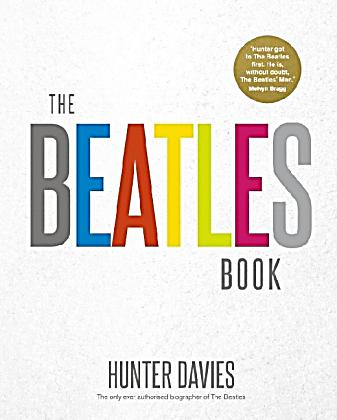
In 2016, he published a book with original Beatles biographer Hunter Davies, plus Spencer Leigh and Keith Badman, called “The Beatles Book”.
As an aside from his Beatles books, David wrote a crime fiction novel in 2017 around a fictional Liverpool detective called Inspector Rocke. Each story is set around a key moment in Beatles history, and features The Beatles themselves, though not as suspects!

In 2018, he was the Associate Producer and Historian for the documentary feature film “Looking for Lennon”, which was nominated for a National Film Award.
In 2018, he also published his third book, with co-author Garry Popper, called “Finding the Fourth Beatle“, about the 23 drummers who put the beat in The Beatles.
He has several other book projects, and much more, on the go.
Make sure you sign up to keep up to date!
You can purchase David’s books in his shop
For the first time, the country music roots of The Beatles are covered in detail, telling how Liverpool had the biggest Country and Western scene in the UK – and probably in Europe – in the 1940s, ‘50s and ‘60s. This influenced The Quarrymen and, of course, The Beatles.
IN 2025, David published his latest book, The Beatles: What If?, written with his friend Andrew Phillips.
They have looked at 70 key moments in Beatles history, where if something had changed, Beatles history could have worked out differently.
What if Ivan Vaughan hadn’t been friends with both John and Paul?
What if The Beatles passed the audition at Decca?
What if they didn’t meet Brian Epstein?
These and many more are examined, and their potential affect on Beatles history is discussed. But will you agree?
You can purchase the Limited Edition HERE
Or you can purchase it from Amazon HERE.

David was the Archive Producer/ Historian for the documentary film, No Hamburg, No Beatles, about The Beatles story in Hamburg. featuring rare archive and photos, together with interviews, this is the definitive story of The Beatles apprenticeship in the clubs of Hamburg.
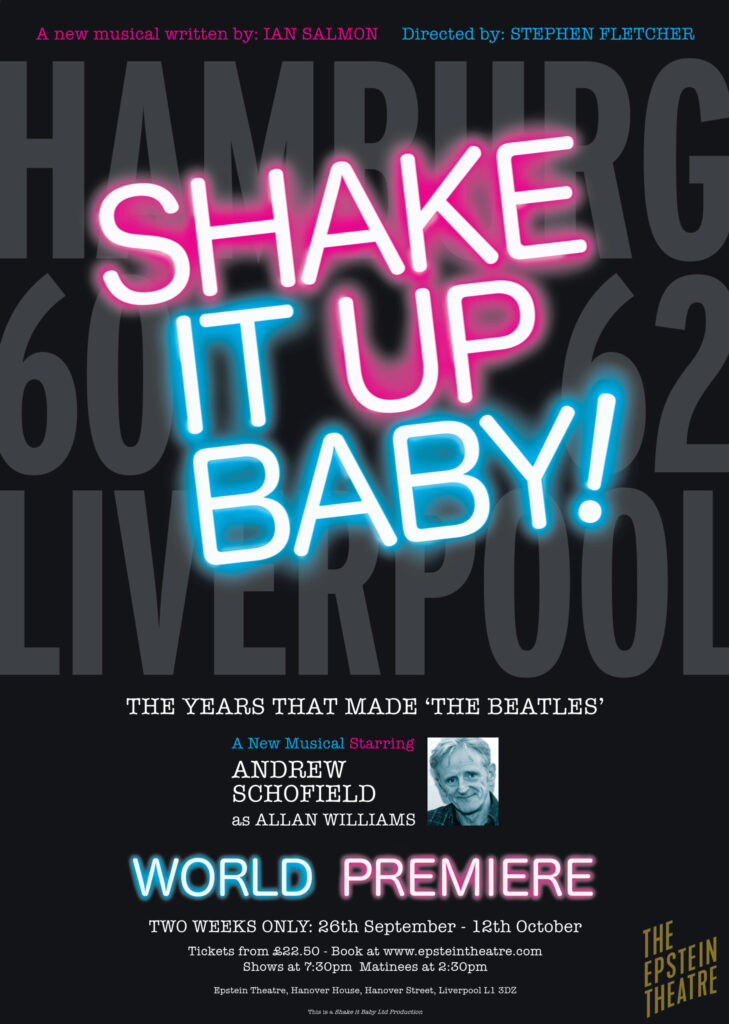
David was the Script Advisor/ Historian for this play written by Ian Salmon and Directed by Stephen Fletcher. It had its premiere in Liverpool at the Epstein Theatre in September 2025.
[fts_twitter twitter_name=@liddypooldave tweets_count=6 cover_photo=no stats_bar=no show_retweets=no show_replies=no]