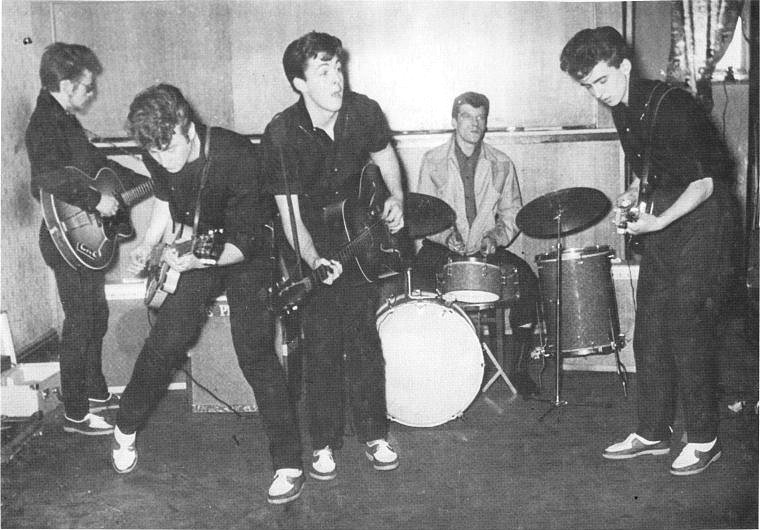
The Quarrymen open the Casbah. George Harrison, Paul McCartney, Ken Brown and John Lennon
1959 is an important year for the group, as, after only a few appearances, they have no more bookings, and George Harrison joins another group, the Les Stewart Quartet. It could have been the end of the road for John, Paul and George, but a twist of fate sees them open The Casbah Coffee Club.
If you want to know the key events in Beatles History, then this is the page for you. This will help you navigate the website, to find the history you need to know. Each link will take you to a different page on the site, where a post, article or interview is located. I will be constantly updating the site, so check back for the latest in Beatles history, discussing Beatles names, Beatles members, Beatles drummers and who the original Beatles were.
15th August 1960 – Pete Best, who joined the previous day, plays his first gig with the now-settled lineup of John, Paul, George, Stuart, and Pete with them called The Beatles.
Why Percy Phillips got there before George Martin did
The First record made by John, Paul and George
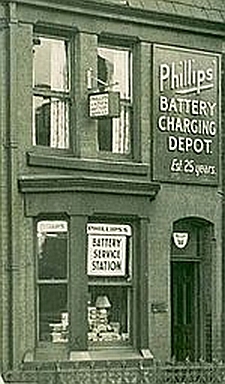
Percy Phillips’ Studio was in the back room of his house
This small studio tucked inside a Victorian terraced house at number 38, Kensington is where The Quarrymen made their first and only demo record. It was a disc that eventually became one of the most historic recordings in popular music. John, Paul, George, Colin Hanton and John Duff Lowe paid seventeen shillings and sixpence (87.5 pence) and cut a two-sided disk made of shellac. They couldn’t afford to pay for a tape and so the recording was made straight to disk.
McCartney/ Harrison Song
The five-piece ensemble recorded Buddy Holly’s “That’ll Be The Day” and “In Spite Of All The Danger”, an original McCartney- Harrison tune. It was seen as Paul’s song with George providing the guitar solo.
Percy Phillips (right) in his studio
Percy Phillips owned the studio, which was on the ground floor. His clients waited in the front parlour and recorded in the back room studio. The studio consisted of two tape-recorders, a microphone hanging from the ceiling, a piano and disc-cutter, which produced these shellac discs.
Interview with Colin Hanton
Colin Hanton spoke about that famous first recording. “We met at a theatre and walked up there. All I remember was this back room with electronic equipment in the corner. We set up our equipment with me in the corner and the lads with their guitars: there were no amps, it was all-acoustic. John Lowe was over by the wall on the piano. I was hitting the drums and he said that they were too loud, so I tried again but there was still the same problem, which was finally fixed by putting a scarf over the snare to soften it and keep it as quiet as possible.
Colin Hanton of The Quarrymen
“John Duff Lowe reckons there was one microphone hanging down from the ceiling, which picked everything up. He was complaining because he said we should get the tape, which was a pound, but we just had enough each— three shillings and sixpence (17.5 pence). I always felt that was one of the reasons to invite John Lowe along to split it five ways. John and Paul went white at the thought of a pound. “Percy was fed up because we were taking too much time, and starting to look at the clock. ‘In Spite Of All The Danger’ was quite long, and he said to chop a verse off. John said no. John Lowe could see Phillips from where he was sitting and he was apparently telling John to finish. We kept going, so the record ended with the song going almost to the centre of the disc, right to the hole in the middle.
We had a record!
In Spite of all the Danger by The Quarrymen
“He gave us the disc and off we went. It was a big thing. How many people had records like popular crooner, Matt Monro? So we had a record too, and could listen to ourselves. We had heard our group before because the girl who lived next door to me, Geraldine Davies, had a Grundig tape recorder. She’d record us and then we’d all sit down and listen to it. It was a momentous day for us. I can still remember it so clearly”.
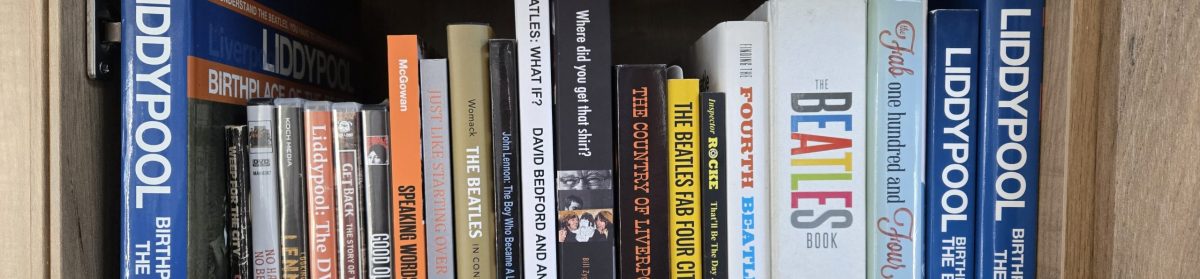
On 10th July 1964, The Beatles arrived in Liverpool for a civic reception at Liverpool’s Town Hall, as well as holding the Northern Premiere of A Hard Day’s Night. The image of them standing on the balcony was so iconic, I decided it should grace the cover of my first book “Liddypool: Birthplace of The Beatles“, published in 2009.
The reception was difficult to arrange, but Brian was determined to make it happen. His letter explained it:
“Thank you very much for your charming letter of the 4th instant. As you probably know the boys and I set forth for the United States tomorrow morning. On their return the boys have an intense filming schedule, which will take them up to the end of April. They will then be resting for most of the month of May. So therefore while I look forward very much to accepting your kind invitation, for which the boys and I are most appreciative, I think the actual date may have to be left in abeyance for the present. With many thanks and best wishes. Yours respectfully, Brian Epstein
On the flight home their thoughts were occupied with this visit to Liverpool. One of the travelling journalists who had accompanied the group down under was from the Liverpool Daily Post and Echo, named, ironically, George Harrison—no relation whatsoever. Harrison’s observation was astute: “Probably for the first time in their show-biz lives our world-famed troubadours are nervous. They aren’t sure how their fellow citizens will react to this home-coming triumph. The four boys are thrilled to their fringes at the honour Liverpool is bestowing upon them. But in the back of their mind is a niggling doubt”.
Harrison spoke to each of The Beatles about how they were feeling as they came closer to their return to Liverpool. Even though all the preparations had been made, Paul McCartney didn’t know if it would click with Liverpool people. “I can’t somehow see all the kids I used to go to school with from Mather Avenue and their parents, turning out to watch young Paul McCartney drive by in a big car, along the road where we used to play together. I don’t think I’d bother to go and cheer for somebody else”, McCartney said honestly, “and I’ve got a feeling that they won’t do it for us either.
“And who is going to stand outside the Town Hall just to see us arrive? Only a couple of years back hardly anybody in Liverpool had heard of us. Now this! I’m keeping my fingers crossed and hoping that everything comes off all right, but I have butterflies in my tummy over it”.
Harrison (the reporter) observed that the manner of The Beatles was one of humility and that “there still isn’t a big head among the four of them. They just can’t believe they are important”.
John Lennon, never normally short of words, could hardly explain how he felt about the forthcoming event. “The only time I’ve ever been at the Town Hall was when they sent me from art school to draw it. Going back like this, in state, or whatever they call it, is a bit scary”. Ringo, however, was more forthcoming. “It’s a funny feeling. Makes you feel small and yet ten feet tall. I mean, all those other places in Australia and New Zealand where we went to civic receptions, they were only parties of people we didn’t know, like. But this is different”, Ringo enthused. “It’s Liverpool. Think of being in that parade from Speke to the Town Hall with some of our old mates probably looking at us and saying; ‘I knew that lot when they were poor’. And that wasn’t so long ago either, was it?” he said with a smile.
Even the “quiet” Beatle had an opinion. George spoke to his namesake with his own perspective. “It’s great that our own home town should do this for us”, he said seriously, “but deep down I have the feeling that there are a lot of Liverpool folk who deserve this honour far more than we do. After all”, he continued modestly, “what have we done? Sang some songs around the place and made money. It doesn’t seem much compared with some things that have been done by many Liverpool men and women who’ve never been honoured”.
The Fab one hundred and Four
The above is taken from my first book “Liddypool“. Little did I know when Liddypool was published what would happen next. Now in its third edition, it has sold over 5,000 copies worldwide, and led to me publishing two further books, “The Fab one hundred and Four: The Evolution of The Beatles” and “Finding the Fourth Beatle“, plus co-authoring “The Beatles Book” with Beatles biographer Hunter Davies. Last year, the first documentary I have consulted on was released; “Looking for Lennon”. I have visited the US a dozen times at various Beatles conventions, and been a guest at other events in Europe, and have several other projects on the go which keeps me in mischief!
Liddypool by David Bedford
Everywhere I go in Liverpool, I see so many Beatles tour guides using “Liddypool” to help give tours to their visitors. I am so privileged, and cannot thank everyone enough for your support.
I love what I do; it is a labour of love. I just want to share my amazing city of Liverpool, and why it was crucial in the evolution of The Beatles; they could not have come from any other city.
Ringo, more than any other Beatle, seems to have received criticism over the years for his ability. Is it justified? “Oh, he is just a lucky guy who was in the right place at the right time.” “You could take Ringo out of The Beatles and you would still have The Beatles.”
Finding the Fourth Beatle
When we started work on “Finding the Fourth Beatle“, one of the main aims was to examine why Ringo became the drummer who made the grade with John, Paul and George. Was he just the happy-go-lucky guy who was around at the right time, or was he really a good drummer, or even a great drummer?
What I soon learned was that as a guitarist/keyboardist, I was not qualified to answer that question adequately. I have read so many authors who either compliment or condemn Pete Best or Ringo Starr because they feel like it, without offering any justification, as if their reputation as an author is good enough. Trust me, it isn’t. I have played with plenty of drummers of varying capabilities, and know the difference between a good and bad drummer, but anything more than that is beyond me.
Drummers on Ringo
And so, what we decided to do was to get experienced drummers to examine Ringo’s drumming (we did the same for Pete Best too) and try to work out whether he was just a lucky guy, or really was the influence that many great drummers say he was. And if he is that good, why?
So we rounded up several drummers who could examine Ringo’s style, and get their feedback. It was illuminating. First, I spoke to Gary Astridge, who is Ringo’s drum curator, and been working with him for years. Gary is also a drummer in a band, so he could explain the details behind Ringo’s kits, and how he plays. Second, I spoke to Rob Shanahan, who is Ringo’s photographer, but is also a drummer, with a similar style to Ringo.
A Lefty on a Righty
One of the distinctive sounds created by Ringo is that he is naturally left-handed, but plays on a right-handed kit. Shanahan is also a lefty on a righty, and explains why this creates quite a unique sound, and how Ringo uses his kit. Ringo has also always kept quite a simple kit, and resisted the trend to have lots of tom-toms and other additions to his kit.
“Plays the Song”
One phrase that keeps cropping up is that Ringo “plays the song”, but what does that mean? It took a while to understand it, and I did that with the help of several drummers who play in Beatles tribute bands. They are the ones who have to learn to play Ringo’s parts, and I never realised how difficult that was. Ringo plays by feel, at that moment, and that exact moment in the song, which could be different every time they recorded it.
“Ringo Starr and The Beatles Beat”
Two drummers who are considered experts on Ringo’s drumming are Alex Cain and Terry McCusker. Their incredible book, “Ringo Starr and The Beatles Beat” examines Ringo’s style on every Beatles song, and they shared their expertise with us by analysing 10 of the songs that define Ringo’s style. It is only when you listen to Beatles songs for the drumming that you truly appreciate his contribution to The Beatles’ sound. Just go listen to songs like “Come Together”, “Rain” and “Strawberry Fields Forever”, and you will gain a new appreciation for his talent.
What Alex and Terry also point out is that Ringo, once The Beatles were getting into more complicated musical arrangements, was heavily involved in the arrangement of the song, and contributed not just drum rhythms, but percussion too. He was no ordinary drummer.
Lucky? No!
Although 3 other drummers were offered the chance to join The Beatles to replace Pete Best, it was Ringo who said yes. And that is just as well! Ringo was the perfect drummer for The Beatles at that time, and became an invaluable, and indispensable, member of the Fab Four.
They Found The Fourth Beatle
As you will read in the book, “Finding the Fourth Beatle“, Ringo was, and still is, a great drummer who inspired a whole new generation of drummers who wanted to play like him. Just read the comments from other leading drummers as to how they feel about Ringo. In conjunction with our findings in “Finding the Fourth Beatle“, it is clear that Ringo is respected as a drummer, and not just because he was a Beatle.
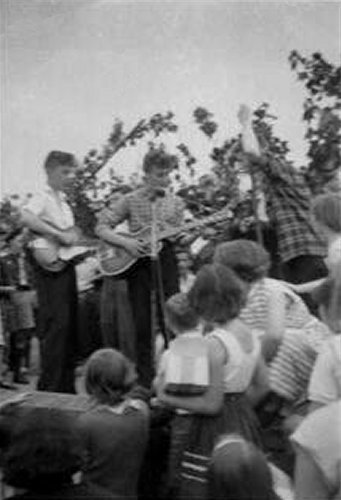
On the day John Lennon meets Paul McCartney, the meeting was about to happen. After the parade, and after Paul had watched John and The Quarrymen perform, the group was over in the church hall, preparing for the evening performance.
St Peter’s Hall and Stage shortly before it was removed
Ivan Vaughan walked in with Paul McCartney, but what happened next?
Who did what? Who said what?
Since I started investigating these key moments in Beatles history, I have interviewed several people who were there at St. Peter’s Church on 6th July 1957. These include: Quarrymen Rod Davis, Eric Griffiths, Colin Hanton and Len Garry, plus eyewitnesses Julia Baird and Ian James. I have also studied the comments made by John Lennon and Paul McCartney. And guess what? Not everyone agrees on 100% of what happened! I did mention to several of them that they should have been taking notes, as the most important meeting in music history was happening, but we can excuse them!
David playing with The Quarrymen at he 50th Anniversary
What we can agree, when collating and conflating the eyewitness accounts, is that most of The Quarrymen were in the hall: Colin Hanton had gone home for tea, and Rod Davis was in the toilet for some of the time! Ivan brought Paul over to meet John, and they were talking for a short while. Paul was intrigued by how John was playing guitar. John explained that he was playing banjo chords, as taught by his mother.
He’s cack-handed!
Most of them agree that John handed Paul his guitar. The first thing Paul did was to alter the tuning, which was more than the other Quarrymen could do; tune a guitar! What astonished them, and must have looked impressive, was that Paul then turned John’s guitar upside down, because he had learned to play a right-handed guitar upside down! This was verified during an interview I did for “The Fab one hundred and Four” with Ian. Paul was left-handed (or cack-handed as we call it. Just don’t ask why!!)
Twenty Flight Rock
Paul then played “Twenty Flight Rock” by Eddie Cochran, and proved he could not only play a guitar upside-down, but he could sing too, and know a new song, including its lyrics. No wonder John was impressed! Paul also sang some of “Long Tall Sally”, not knowing how important that song was to John (that will be a future blog post).
After a short time, Paul left to go home, and John was left with the decision; should he let Paul join, even though he was better than him, but would improve the group?
John made the right decision; Paul would be invited to join, thus creating the Lennon/McCartney partnership that would change modern music.
The story of how John and Paul met for the first time on 6th July is a fascinating one, because it has the strangest of coincidences connected with it.
When John moved in with his Aunt Mimi and Uncle George in 1946, the first friend he made was Ivan Vaughan, who lived in Vale Road, just behind “Mendips”. When Ivan moved from Lidderdale Infants School to Dovedale Primary School at the age of 8, he and John became even closer, even though he was a year behind John.
“THAT Lennon!”
However, with John’s reputation among the parents in Woolton, when it came for Ivan to go to Grammar School, Mr and Mrs Vaughan didn’t want their son following John to Quarry Bank! Known by parents as “THAT Lennon!”, they didn’t want their precious son, who was very intelligent, being corrupted by Lennon. And so they took the decision to send him all the way into the city centre to the Liverpool Institute.
John Lennon (second from left) and Ivan Vaughan (second from right) in the Isle of Man
The Same Birthday
At the Liverpool Institute, Ivan ended up in the same class as a lad born on exactly the same day as him; Paul McCartney. The two became friends, with a mutual interest in music, and so Ivan told Paul all about his friend’s skiffle group called The Quarrymen, which Ivan occasionally played in. He told Paul that The Quarrymen were performing at the Woolton Fete on 6th July (1957) and invited him to come along. Paul was indecisive at first, but when Ivan told him it was a good place to meet girls, how could he refuse!
John, Meet Paul
And so, on 6th July 1957, Ivan brought Paul along to St. Peter’s Church, and introduced him to John Lennon.
Without Ivan, the most important meeting in music history would never have taken place. John and Paul lived in different parts of Liverpool, went to different schools, and had different groups of friends, all apart from Ivan. And so, thanks to Mr and Mrs Vaughan wanting to keep their son away from John Lennon, they inadvertently connected John and Paul, and thus led to the birth of The Beatles.
Thank you Mr and Mrs Vaughan, and especially Ivan.