“Carl Jung” – Liverpool is the pool of life. “I FOUND myself in a dirty, sooty city. It was night, and winter, and dark, and raining. I was in Liverpool.” But Carl Gustav Jung, the man who famously concluded that “Liverpool is the pool of life” – never was.
Carl Gustav Jung 26 July 1875 – 6 June 1961) was a Swiss psychiatrist and the founder of analytical psychology, who worked with Sigmund Freud.
“Fred Astaire” – Fred and Ginger, Alf and Julia. Alf “Fred” Lennon and Julia “Ginger” Stanley both loved dancing and were the Fred and Ginger of Liverpool!
“Sir Robert Peel” – A two-time Prime Minister of Great Britain, Sir Robert Peel was a major force behind easing restrictions on Catholics in Britain and the reformation of the judicial system in the 1830s. He was later considered to be an enemy to his own Conservative party when he went against his own political interest to repeal the Corn Laws to help alleviate the effects of the Irish Famine in the 1840s. John Lennon’s great-grandparents came over from Ireland in the 1840s so this would have helped the Lennon family.
“Tommy Handley” – Liverpool comedian. Thomas Reginald “Tommy” Handley (17 January 1892 – 9 January 1949) was a British comedian, mainly known for the BBC radio program ITMA (“It’s That Man Again”). He was born at Toxteth Park (where John’s parents Alf Lennon and Julia Stanley were from), Liverpool in Lancashire. The Beatles would have listened to Tommy Handley on the radio, one of many Liverpool comedians, like Ted Ray, Arthur Askey, and Rob Wilton.
“Albert Stubbins” – from Newcastle. One of the best centre-forwards of his generation, in the 1940s, he moved from Newcastle to Liverpool FC for £13,000 in 1946. Liverpool’s rivals, Everton FC also tried to sign him, so he decided on the toss of a coin between Liverpool and Everton. Liverpool won! Why would he be there, as none of The Beatles were particularly sporty? When John was at Dovedale School, around the age of seven, he wrote a paper called “Sport and Speed, Illustrated”. This would have been the time when Stubbins was scoring regularly for Liverpool FC. Maybe that is why he appears on the cover.
“Anonymous Legionnaire: RAOB” – Hiding behind actress Diana Dors is a member of the Royal Antediluvian Order of Buffaloes. The fraternal organization, which started in 1822, raises money for charities and provides assistance to its members and their families in times of need. This isn’t a random selection. John’s uncles, Charlie and Herbert Lennon, were members of The Dingle Lodge 4303, which was situated at 36, Devonshire Road, just two doors away from my childhood home of 40, Devonshire Road.
To find out more about The Beatles and Liverpool, you can order the brand new Third Edition of “Liddypool: Birthplace of The Beatles” from www.davidabedford.com
David Bedford
Category: Uncategorized
TV Appearance about The Fab104

I was interviewed recently by BayTV, Liverpool’s own cable TV channel, about “The Fab one hundred and Four: The Evolution of The Beatles”. Tim Quinn was the interviewer, and we actually chatted for nearly 40 minutes! Good fun.
The video is on their Youtube channel and on my website at www.davidabedford.com
How John Lennon and Pete Shotton robbed a house for a tea-chest bass!
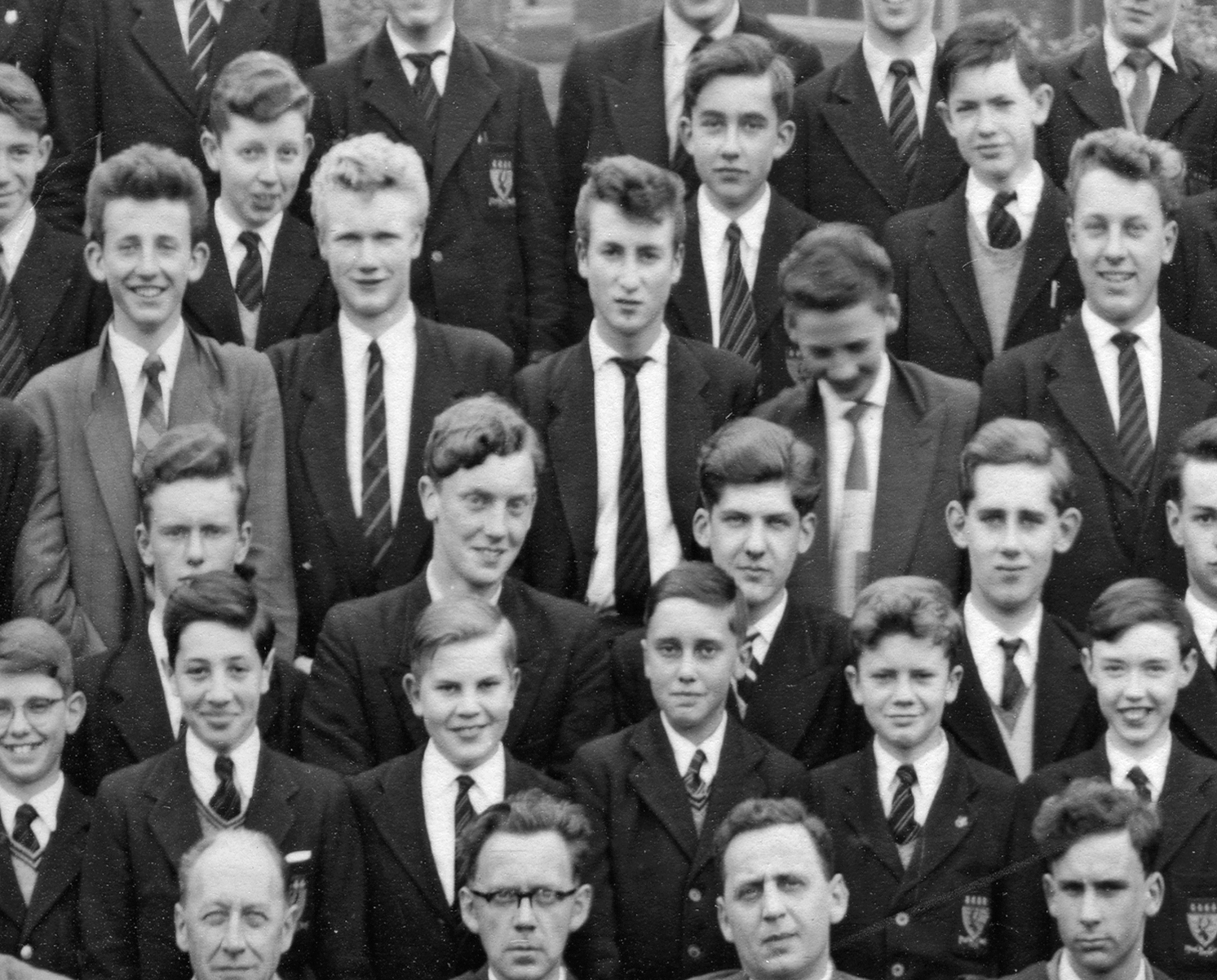
In the first look at the Fab 104, we examined the impact and importance of George Smith, Julia Lennon and, of course, harmonica tutor Arthur Pendleton. This time we look at the founding members of The Quarrymen: John Lennon, Pete Shotton and Bill Smith.
In a rare interview, Bill Smith told me where they formed the group and how they came up with the name, The Quarrymen – and who didn’t like the suggestion! They may look innocent, but in the photo we see, from left to right, Bill Smith, Pete Shotton, John Lennon, Don Beattie and Michael Hill (more on the latter two guys later). Bill also told me why his collar is up, and the story behind the hairstyles. Bill was the first tea-chest bass player with the group, but when he left the group, Lennon and Shotton broke into Bill’s house and stole it! But Bill took it back! Read Bill’s story in “The Fab One Hundred and Four: The Evolution of The Beatles” at www.fab104.com
David Bedford
The Beatles: You Tell Me That It’s Evolution, well, you know…………or do you?
Could you tell someone how they went from the Quarrymen to the Beatles? I started researching it and therefore started writing “The FAB one hundred and Four: The Evolution of The Beatles”. And I was amazed – there were 104 people! I went looking for the musicians who played with every incarnation of the group, plus those who taught The Beatles to play, and those who played a significant part in the evolution of the Beatles, from the first Fab Four: John Lennon, Pete Shotton, Bill Smith and Eric Griffiths, to the famous Fab Four: John, Paul, George and Ringo.
Follow me on a journey from the very start of The Beatles to the end of 1962 when Ringo Starr had become the final piece of the jigsaw in the Fab Four.
It all started with John Lennon, and in particular, the influence of his mum Julia. Having been separated from his mother at the age of 5, he reconnected with her in his early teens, and she became a major instigator in Lennon’s musical journey. As Julia played banjo, ukulele and piano there was always music in the house, and she encouraged her son with his musical ambitions.
However, once he had a guitar, because he couldn’t play it or tune it properly, John tuned his guitar to his mother’s banjo, and so learned to play only banjo chords on his guitar. When he met Paul on 6th July 1957, he was playing banjo chords, which confused the young McCartney.
Julia also wanted to encourage him to learn to play the harmonica that his uncle George had given him. Julia’s neighbour, Arthur Pendleton, was a keen harmonica player, and so Julia sent young John to take lessons from Arthur. Those lessons, and not lessons from Delbert McLinton, helped to form the distinctive sound that caught the ear of George Martin, and underpinned the Beatles’ first hit singles.
Next time: how John acquired his first guitar.
For more information go to www.fab104.com
David Bedford

The Beatles back Davy Jones
At the famous Liverpool Stadium concert on 3 May 1960, when Gene Vincent appeared with several Liverpool groups following Eddie Cochran’s death, one of those artists on the bill was the black American singer Davy Jones, not to be confused with the late singer from The Monkees.
Jones returned to Liverpool at the end of 1961 and during The Beatles’ appearance at Sam Leach’s second “Operation Big Beat”, he got up on the stage as an unannounced guest and sang two numbers with the group.
This was shortly followed by two official appearances. First, Jones was booked by Ray McFall to appear at The Cavern on Friday 8 December 1961. Since he was a solo singer, Jones needed a backing band, so McFall arranged for The Beatles to support him. The session was photographed for Mersey Beat. That same evening, Leach was promoting another event at the Tower Ballroom in New Brighton and once again had Jones on the bill. As at The Cavern, The Beatles were booked to support him. Leach had advertised Jones as the Saturday Spectacular television star and
highlighted Jones’ status as a successful recording artist.
Read more about this historic appearance and how Cavern DJ Bob Wooler got stoned on a cocaine, thanks to Jones, in The Fab One Hundred and Four – get your copy now at www.fab104.com
David Bedford
www.fab104.com
# arts and entertainment
Why We Should Thank Arthur Pendleton for “Love Me Do”
When we think about the early Beatles’ sound, John’s harmonica playing makes it stand out.
Find out about the man who taught John to play in “The Fab One Hundred and Four”
David
The Evolution of The Beatles – from the very beginning!

If somebody asked you: “How did they go from being The Quarrymen to The Beatles?”, what would you say?
I’ve spent the last 14 years researching and writing about the early history of The Beatles in my first book, “Liddypool: Birthplace of The Beatles” and my new book, “The Fab one hundred and Four: The Evolution of The Beatles”.
Over the next few weeks, I will take you on that journey with the whole story – including some surprise names, and revealing for the first time the previously unknown school friend who suggested to John that he should start a skiffle group!
Names like Arthur Pendleton, Everett Estridge, Simone Jackson and Ian James deserve credit for the important part they played in the evolution of The Beatles.
Make sure you don’t miss it!
David Bedford
www.fab104.com
The Day John Lennon Met Paul McCartney – First Published Photos of Parade
6th July 1957 will go down in music history as the day John Lennon met Paul McCartney for the first time, and everything changed!
John’s group The Quarrymen had been added to the program for the annual Woolton Village Fete being held at St. Peter’s Church, Woolton.
For my latest book, “The Fab one hundred and Four: The Evolution of The Beatles”, I have spoken to many key eyewitnesses, including The Quarrymen, to piece together the true story of that momentous day.
Also included in a book for the very first time are the photographs taken by Quarrymen banjo player Rod Davis’ father of the parade, where you can see the marching band, the scouts and guides, young people’s groups and of course, The Quarrymen themselves.
However, the key interview was with Ian James, Paul McCartney’s school friend who revealed the secret behind the success of Paul’s audition to John. Ian taught Paul to play guitar and went on to give both John and George lessons. Ian confirmed what we had long suspected about Paul’s audition in the church hall of St. Peter’s – that Paul had learned to play a right-handed guitar upside down!
Read the full story in “The Fab One Hundred and Four” – more details at www.fab104.com
READ PART 2 – When John met Paul
“A treasure chest of research and a visual delight, this will prove to be a work no Beatles fan should be without.”
Bill Harry, founder of Mersey Beat
“David is defining and refining Beatles history” – Edd Raineri, The Beatledd Fab Four Hour
I READ THE NEWS TODAY, OH BOY! “Check out “The Fab One Hundred and Four,” a new book written by author/ Beatles scholar David Bedford. Exhaustively researched and illustrated with terrific (and rare) photos, the book tills the fertile soil of the band’s early history by examining the Liverpool musicians who influenced John Lennon, Paul McCartney, George Harrison and Ringo Starr” Michael Starr, New York Post
Read the full story in “The Fab One Hundred and Four” – more details at www.fab104.com
Beatles Fans: We need your help to Save Ringo Starr’s Birthplace and the Welsh Streets
I have been involved for the last few years in a campaign to save the birthplace of Ringo Starr at 9, Madryn Street in the Dingle. The campaign also includes all of the “Welsh” Streets that include Madryn Street, the area where I grew up.
We need to raise £40,000 to fund the public enquiry, for which I have given written evidence and may be asked to appear before the enquiry.
There are lots of incentives for anyone who contributes to the fund, including copies of my two books, “Liddypool” and “The Fab one hundred and Four: The Evolution of The Beatles” and many more.
Please join us and preserve the Dingle! Read the Press Release below for more details.
David Bedford
www.liddypool.com
www.fab104.com
PRESS RELEASE 2 JUNE 2014
Save launches crowd funding initiative to raise funds for a public inquiry into the Welsh Streets, Liverpool
http://digventures.com/projects/save-the-welsh-streets-2014/

On June 17th a public inquiry begins in Liverpool into planning application to demolish over 400 Victorian terraced houses in Toxteth, L8, including most of Madryn Street, where Ringo Starr was born.
The streets are to be replaced with drastically fewer semi-detached and detached houses with gardens, dropping the density by some 45% percent despite the proximity of the area to the city centre. Only forty houses are to be refurbished.
SAVE has been campaigning to save the Welsh Streets for over 10 years. In 2011 SAVE bought a property there – 21 Madryn Street, the former home of Ringo Starr’s aunt. SAVE bought the house to show that with minimal investment it is possible to make these terraces into comfortable homes. A young couple has been happily living there ever since.
The grounds for the public inquiry include whether it fails in terms of national housing and planning policy, issues of design, sustainability and architectural significance.
SAVE has made several significant discoveries in the course of gathering its evidence for the inquiry.
One of the chief among these is that the Welsh Streets were laid out and built by prominent Welsh architect Richard Owens, who master-planned large areas of Liverpool in the last quarter of the 19th century.
Owens was the embodiment of the strong Welsh element that contributed to the history and construction of Liverpool at its great moment of expansion in the late 19th century. The Welsh Streets are named after Welsh landmarks, the houses were built and partly inhabited by Welsh builders, and the area was a Welsh community for many years.
This evidence has been uncovered for the first time by one of our witnesses, Gareth Carr, who completed a PhD about Richard Owens at the Liverpool University architecture faculty this year.
Another aspect of SAVE’s evidence is how deeply connected the wider area is to Ringo Starr’s background, and not only the house where he was born. Starr was born at No.9 Madryn Street, and spent his first five years there; his grandparents lived at the other end of the street, his aunt lived at No.21, and his best friend at No.10. Following this he moved two streets away where he lived until he went to London after becoming an international mega star with the Beatles.
While an agreement between former Housing Minister Grant Shapps and Liverpool Mayor Joe Anderson was made in 2012 to save 16 houses on Madryn Street, SAVE holds that it is important to keep the entire street in tact.
In addition, SAVE holds that it is viable to refurbish the houses, and presents a more sustainable approach. This position is supported by a recent survey of the site, undertaken jointly with Liverpool Council. Evidence from our surveyors and QS indicate that refurbishment will cost between £51,000 and £60,000 on the properties – with scope for this figure to drop if individuals take on refurbishment of their own homes, or if a developer refurbishes a groups of houses. Evidence from estate agent Paul Sutton indicates that the houses would sell for between £75,000 and £85,000.
SAVE needs to raise £40,000 to fight the inquiry, and has embarked on a crowd-funding initiative with Dig Ventures, a platform that has successfully raised money for several UK archaeological digs. Supporters of our campaign are eligible for a variety of benefits including tailored Beatles-themed or architectural tours of Liverpool, tickets to a party at The Empress pub that features on the front of Ringo’s solo album A Sentimental Journey, a tea towel that is being especially designed for the campaign, membership of SAVE and SAVE publications. The top prizes are tea at 21 Madryn Street which is at present being redesigned by Tilly and Wayne Hemingway of Hemingway Designs, and participation in a discussion about the future of No9 Madryn Street, held at 21 Madryn Street with members of the team.
Fighting public inquiries is an expensive business, and SAVE is a small independent charity that receives no public funding. Our experts are giving their time for free or at greatly reduced rates, investing some £200,000 of donated time to this fight for which we are hugely grateful. We still need to raise another £40,000 to cover legal fees, the cost of a survey of a number of houses on the site, towards the redecoration of the house, and other expenses.
SAVE Director Clem Cecil says: “This is the first crowdfunding campaign of its kind in the UK, and we are really looking forward to involving everyone who supports us in the fight to save this neighbourhood. We’re offering great campaign benefits, and raising awareness about what is happening here among Beatles fans, and those interested in Welsh-Liverpool history. This is a way for them to get actively involved.”
http://digventures.com/projects/save-the-welsh-streets-2014/
SAVE’s vision for Madryn Street

Notes to editors:
SAVE Britain’s Heritage has been campaigning for historic buildings since its formation in 1975 by a group of architects, journalists and planners. It is a strong, independent voice in conservation, free to respond rapidly to emergencies and to speak out loud for the historic built environment.
SAVE Britain’s Heritage, 70 Cowcross Street, London EC1M 6EJ
Registered Charity 269129
Tel. 020 7253 3500 Email office@savebritainsheritage.org
www.savebritainsheritage.org
Follow SAVE on Twitter: @SAVEBrit
On the anniversary of Sgt Pepper, how many of the Fab104 can you spot?
When I was writing my book, and the number kept rising, I considered doing a tribute to Sgt. Pepper with as many of the Fab one hundred and Four I could find. In the end we decided not to proceed with it, but see how many you can recognise?
If you want to know more about the 104 people involved in the story of the Beatles, you can order “The Fab one hundred and Four: The Evolution of The Beatles, 1956-1962” from www.fab104.com
Have fun!
David