“Carl Jung” – Liverpool is the pool of life. “I FOUND myself in a dirty, sooty city. It was night, and winter, and dark, and raining. I was in Liverpool.” But Carl Gustav Jung, the man who famously concluded that “Liverpool is the pool of life” – never was.
Carl Gustav Jung 26 July 1875 – 6 June 1961) was a Swiss psychiatrist and the founder of analytical psychology, who worked with Sigmund Freud.
“Fred Astaire” – Fred and Ginger, Alf and Julia. Alf “Fred” Lennon and Julia “Ginger” Stanley both loved dancing and were the Fred and Ginger of Liverpool!
“Sir Robert Peel” – A two-time Prime Minister of Great Britain, Sir Robert Peel was a major force behind easing restrictions on Catholics in Britain and the reformation of the judicial system in the 1830s. He was later considered to be an enemy to his own Conservative party when he went against his own political interest to repeal the Corn Laws to help alleviate the effects of the Irish Famine in the 1840s. John Lennon’s great-grandparents came over from Ireland in the 1840s so this would have helped the Lennon family.
“Tommy Handley” – Liverpool comedian. Thomas Reginald “Tommy” Handley (17 January 1892 – 9 January 1949) was a British comedian, mainly known for the BBC radio program ITMA (“It’s That Man Again”). He was born at Toxteth Park (where John’s parents Alf Lennon and Julia Stanley were from), Liverpool in Lancashire. The Beatles would have listened to Tommy Handley on the radio, one of many Liverpool comedians, like Ted Ray, Arthur Askey, and Rob Wilton.
“Albert Stubbins” – from Newcastle. One of the best centre-forwards of his generation, in the 1940s, he moved from Newcastle to Liverpool FC for £13,000 in 1946. Liverpool’s rivals, Everton FC also tried to sign him, so he decided on the toss of a coin between Liverpool and Everton. Liverpool won! Why would he be there, as none of The Beatles were particularly sporty? When John was at Dovedale School, around the age of seven, he wrote a paper called “Sport and Speed, Illustrated”. This would have been the time when Stubbins was scoring regularly for Liverpool FC. Maybe that is why he appears on the cover.
“Anonymous Legionnaire: RAOB” – Hiding behind actress Diana Dors is a member of the Royal Antediluvian Order of Buffaloes. The fraternal organization, which started in 1822, raises money for charities and provides assistance to its members and their families in times of need. This isn’t a random selection. John’s uncles, Charlie and Herbert Lennon, were members of The Dingle Lodge 4303, which was situated at 36, Devonshire Road, just two doors away from my childhood home of 40, Devonshire Road.
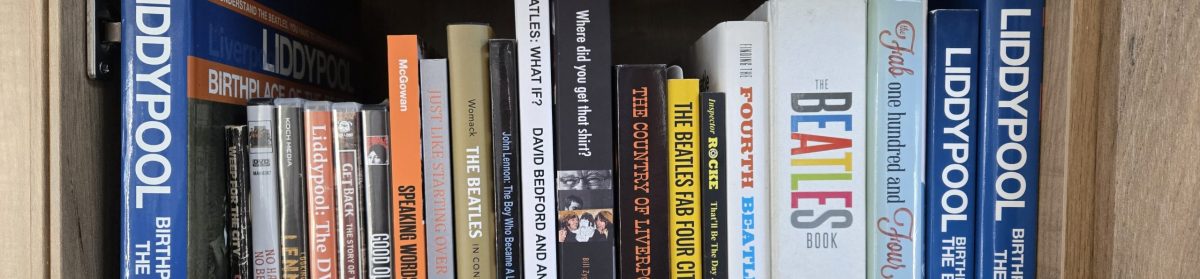
To find out more about The Beatles and Liverpool, you can order the brand new Third Edition of “Liddypool: Birthplace of The Beatles” from www.davidabedford.com
David Bedford
Category: arts & entertainment
8 Days A Week (I Ain’t Got Nothing But..)
The film was a huge disappointment to me. Some nice footage, and bits of commentary from Paul and Ringo, but this was not a film for serious die-hard Beatles fans.
When we were told a couple of years ago that The Beatles were going to be captured in a new, fresh, exciting film, directed by the legendary director Ron Howard, there was great excitement among Beatles fans.
We were promised new footage, new photos, behind the scenes interviews and the first truly new Beatles film since the 1960s.
I attended the world premiere in Liverpool – we were screening 30 minutes ahead of London – and I walked the “blue jay way” carpet with Allan Williams, The Quarrymen, Julia Baird and many more, which was an honour. In the cinema, when we watched interviews with Allan and Beryl Williams, Joe Flannery, Freda Kelly and other Liverpool people, I was so pleased that the film started with the Beatles in Liverpool.
However, when that finished after 20 minutes, I realised something was not quite as it seemed. This film was only for us in Liverpool. Ron Howard, Paul McCartney and Ringo Starr appeared on the screens with a special intro for us, where Ron Howard aditted he hadn’t been to Liverpool but he would like to. Seriously? But then as Liverpool wasn’t to feature in the main film, I suppose it didn’t matter. Where were The Beatles from? Ermmm. Where were The Quarrymen? Stuart Sutcliffe? Pete Best, who probably played more hours live with The Beatles than Ringo, but no mention.
The film was a huge disappointment to me. Some nice footage, and bits of commentary from Paul and Ringo, but this was not a film for serious die-hard Beatles fans, but a nice trip through the Beatles touring years. The one thing it did show well was how fed up with touring the Beatles were by 1966. That was about it. There was nothing particularly new, and plenty I’d seen elsewhere and so much more they could have included, but didn’t.
There was no new insight into touring with The Beatles, and, as a Liverpudlian, this film was definitely made for the American market. Even when a clip was shown of The Beatles on the balcony in Liverpool in July 1964, there was no caption to tell you where it was, even though virtually everywhere else was captioned. When they showed The Beatles in Amsterdam in June 1964, there was Jimmie Nicol standing in for Ringo, but he was not name-checked or identified and just passed over to when Ringo rejoined the tour.
Oh, and I nearly forgot. The people they interviewed. Not ordinary fans, but they rolled out celebrities! Of course, the famous “Fifth Beatles” Richard Curtis, Eddie Izzard, Jon Savage, Whoopi Goldberg, Sigourney Weaver…………………Yes, right.
I could go on, because there were so many disappointments there’s not enough space! This was a huge opportunity missed.
Would I pay to see it again? No.
Would I recommend it to others? No.
Will I buy it on DVD? Probably not.
Was I disappointed? Definitely.
I ain’t got nothing but disappointment, babe, Eight Days A Week.
David Bedford
19th October 1961: You Can’t Beat The Beatles as The Beatmakers!
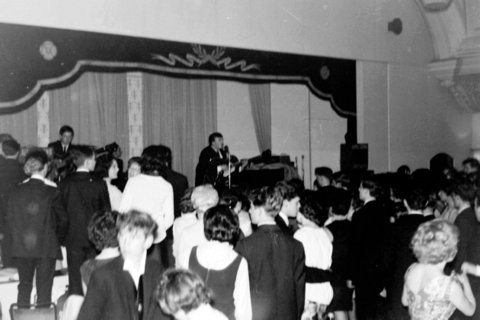
On 19th October 1961, one of the greatest line-ups in Merseybeat history occurred at Litherland Town Hall. The Beatles, together with Gerry and the Pacemakers and singer Karl Terry joined forces on stage.
The Beatmakers
The Beatmakers were — John Lennon, Paul McCartney, George Harrison, Pete Best, Gerry Marsden, Freddie Marsden, Les Chadwick, Les Maguire and Karl Terry.
Two Drummers, Three Guitarists, One Bass, A Piano, A Saxophone and A Singer
There was George on lead guitar and Paul playing rhythm, with the drumming duties split between Pete Best and Freddie Marsden. Les Chadwick played bass guitar and John Lennon played piano with Karl Terry joining in the vocals. Finally, Gerry Marsden played guitar and sang, while Les Maguire played the saxophone.
Gerry and the Pacemakers
Gerry Marsden formed the Pacemakers in 1959 with his brother Fred, Les Chadwick and Arthur McMahon. They rivalled The Beatles early in their career, playing in Liverpool and Hamburg. In 1961, McMahon was replaced on piano by Les Maguire. The band’s original name was Gerry Marsden and The Mars Bars, but they were forced to change this when the Mars Company, who produced the chocolate bar, complained.
Signed by Brian Epstein
The band was the second group to sign with Brian Epstein (who was born on 19th October 1934, 27 years to the day before this Beatmakers’ performance), who later signed them with Columbia Records (a sister label to The Beatles’ Parlophone under EMI). Their first single was 1963’s “How Do You Do It?”, the song The Beatles turned down to be their first single.
Karl Terry
The other member of The Beatmakers was Karl Terry, who started singing when he first heard “Rock Around The Clock” and hasn’t stopped singing since. He joined a skiffle group, The Gamblers, which evolved into Terry and the Teenaces and eventually Karl Terry and the Cruisers. As well as sharing a stage with The Beatles, he appeared on the bill with some of the biggest names in pop history, like Tom Jones, The Shadows, Gene Vincent, The Crickets and many more.

Find out more in “The Fab one hundred and Four: The Evolution of The Beatles”
David Bedford