If you want to know the key events in Beatles History, then this is the page for you. This will help you navigate the website, to find the history you need to know. Each link will take you to a different page on the site, where a post, article or interview is located. I will be constantly updating the site, so check back for the latest in Beatles history, discussing Beatles names, Beatles members, Beatles drummers and who the original Beatles were.
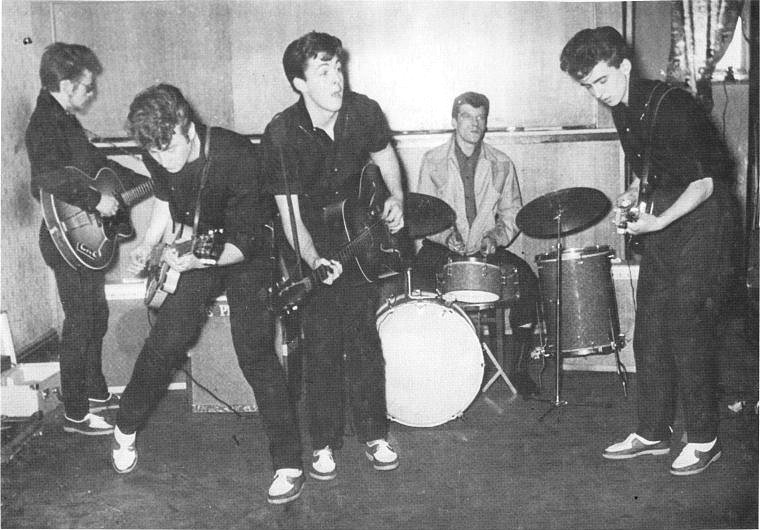
15th August 1960 – Pete Best, who joined the previous day, plays his first gig with the now-settled lineup of John, Paul, George, Stuart, and Pete with them called The Beatles.
How did The Beatles get their name? And how many Beatles names have there been?
When John Lennon, Paul McCartney and George Harrison decided they had had enough of the name “Quarrymen”, it was their latest recruit, Stuart Sutcliffe, who suggested a new name. In tribute to their hero Buddy Holly, whose group was called The Crickets, Stuart suggested “Beetles”. But how would it be spelled? In 1960, the group used many spellings, and variations, of the name Beetles. Interestingly, before calling themselves The Crickets, Holly’s group considered the name “Beetles” too. (Fab one hundred and Four)
the Beetles Myth
One often quoted myth can be debunked, which was quoted by George Harrison. The name was not inspired by the 1953 Marlon Brando film The Wild One, which refers to the rival gang led by Lee Marvin as “The Beetles”. The film was banned in England by the British Board of Film Censors until 1968.
27th March 1960: The Beatals
The first recorded use of the Beatles name was “Beatals”, in a letter written by Stuart Sutcliffe on 27th March 1960, calling himself The Beatals’ “manager”.
Stu has crossed out Quarrymen and used the name BEATALS
23rd April 1960: The Nerk Twins
The Fox and Hounds pub in Caversham, Berkshire was the venue for an unlikely pairing of two of The Beatles. John and Paul played on consecutive nights at this little village pub as The Nerk Twins, to only a handful of people. So how did they end up in the south of England in a tiny village pub?
They were in the Fox and Hounds because it was run by Paul’s cousin Bett and her husband Mike. The couple had both worked as Butlin’s Redcoats before taking on the pub and the teenage Lennon and McCartney were keen to get their advice. The Nerk Twins perched themselves on bar stools and, with their acoustic guitars and no microphones, played a set of songs together.
“It was the Easter school holidays and John and I had hitchhiked down from Liverpool to help out in the pub,” Paul recalled. “We generally dossed around for a week and worked behind the bar. Then Mike said that me and John should play there on the Saturday night. So we made our own posters and put them up in the pub: ‘Saturday Night – Live Appearance – The Nerk Twins’. It was the smallest gig I’ve ever done. We were only playing to a small roomful.” (Fab one hundred and Four)
10th May 1960: The Silver Beetles/ Silver Beatles
The Silver Beatles with Johnny Hutchinson drumming
After the concert on 5th May 1960 featuring Gene Vincent alongside Liverpool groups, John, Paul, George and Stuart approached Allan Williams to be their manager. He agreed, and his first job was to find them a drummer; he achieved that. Tommy Moore joined the group, now known as The Silver Beetles – or The Silver Beatles. Nobody is exactly sure which spelling was used and when over the next couple of months. The first time it was used was on 10th May 1960, when music promoter Larry Parnes came to Liverpool seeking a backing band for his latest star; Liverpool-born Billy Fury (born Ronnie Wycherly in the Dingle).
Tommy Moore was late for his first appearance, so Johnny Hutchinson sat in until Moore turned up. (Full story and biographies in Finding the Fourth Beatle)
14th May 1960: The Silver Beats
The Silver Beats
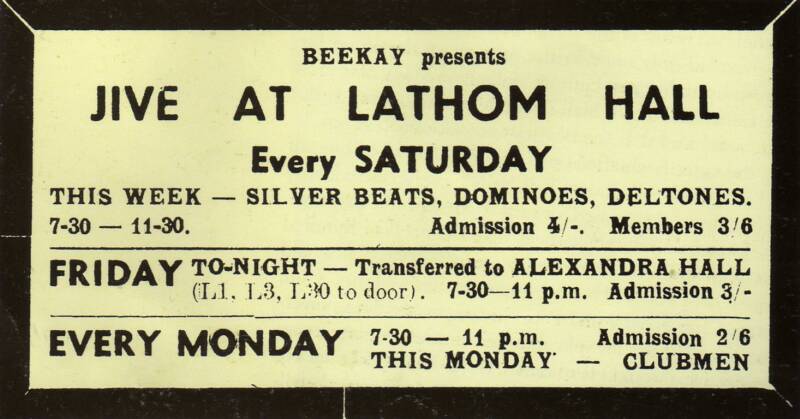
Appearing as The Silver Beats – the only time they used this name – the group played at Lathom Hall, in the north of Liverpool, on 14 May 1960. Their drummer Tommy Moore was with them, but because he did not have his kit, they asked Cliff Roberts to fill in. In many reference books, there is confusion over which Cliff Roberts played that night, and most of them refer to Cliff Roberts and The Rockers. However, the Rockers’ Cliff Roberts was a singer and guitarist, not a drummer. The Cliff Roberts who played with The Silver Beats was the drummer with The Dominoes.
Johnny Gentle and His Group/ The Beatals
Although they didn’t pass the audition to back Billy Fury, The Silver Beatles did enough to persuade Larry Parnes to hire them to back another Liverpool-born artist, Johnny Gentle. They spent two weeks travelling around Scotland, billed only as “His Group”. However, the first set of autographs to show a variation on the Beatles name was signed on this tour, as The Beatals, using their stage names; Paul Ramon, Carl Harrison, Stuart de Stael. John Lennon always swore he never used a pseudonym, though it has been suggested he called himself Johnny Silver, or Johnny Lennon, or a variation on that. Tommy Moore was simply Thomas Moore.
The Beatals autographs
The Silver Beatles / Silver Beetles
On their return from Scotland, Tommy Moore decided he had had enough of John Lennon, and quit the group. With temporary drummers Jackie Lomax and Ronnie the “Ted”, as well as Paul McCartney, they soon recruited Norman Chapman, who only lasted a few weeks.
The Beatles
Reference to The Beatles in Neston
One of the places the group played in June 1960 was the Neston Civic Hall, and the local newspaper published a review, referring to them as The Beatles, the first time it had appeared in print.
The Man on the Flaming Pie?
So what about the “Man on the Flaming Pie”? Although Paul McCartney had an album titled Flaming Pie, and had a song; “I’m the Man on the Flaming Pie”, he wasn’t. On Page 2 of the first issue of Bill Harry’s Mersey Beat, John Lennon wrote his biography of the origins of the group, which Bill Harry titled “Being a Short Diversion on the Origins of Beatles (Translated from The John Lennon).”
In it, Lennon wrote:
“Many people ask what are Beatles? Why Beatles? Ugh, Beatles, how did the name arrive? So we will tell you. It came in a vision – a man appeared on a flaming pie and said unto them ‘From this day on you are Beatles with an ‘A’. Thank you, mister man, they said, thanking him.“
For years, many have scoffed at this as a bit of fun. However, there is a true story behind the “man on the flaming pie”, as detailed in The Fab one hundred and Four. His name is Royston Ellis, and he was a Beat Poet who visited Liverpool, and was backed by a group, known as The Beetles, at Liverpool University. I interviewed him for the book, and he told me the story of what happened in Gambier Terrace, looking every bit like a Beatnik paradise. He sat there with John, Paul, George and Stu, and discussed the possibility of them coming back down to London to back him as a beat group.
While there, they had an experience with a drug, of sorts, remembered by John later:
Royston Ellis
‘By the way, the first dope, from a Benzedrine inhaler, was given to The Beatles (John, George, Paul and Stuart) by an (in retrospect) obviously ‘English cover version of Allen – one Royston Ellis, known as beat-poet (he read poetry whilst we played 12-bar blues at the local in-place!). So give the saint his due. Love, John Lennon
Record Mirror mentioning The Beetles
Whether it was under the influence of “Vicks” or not, Royston Ellis and John Lennon had a discussion about their group’s name. In a newspaper report, Ellise refers to the group The Beetles, and how he is hoping to bring them down to London as his backing group. “John and George liked the idea, though Paul and Stu were less keen.”
Beetles with an “A”
“I suggested that since they liked the beat scene and they were coming to London to back me, a beat poet, why not spell it with an ‘A’? I had bought a chicken pie and mushrooms for dinner. I might have had the money but I did not know much about cooking, and the result was that I overcooked the mushrooms and burnt the chicken pie. I have always assumed that gave rise to John’s reference to ‘a man on a flaming pie’ suggesting they call themselves Beatles with an A.” (Fab one hundred and Four)
And very soon afterwards, they settled on Beatles with an “A”, never to be changed.
Why Percy Phillips got there before George Martin did
The First record made by John, Paul and George
Percy Phillips’ Studio was in the back room of his house
This small studio tucked inside a Victorian terraced house at number 38, Kensington is where The Quarrymen made their first and only demo record. It was a disc that eventually became one of the most historic recordings in popular music. John, Paul, George, Colin Hanton and John Duff Lowe paid seventeen shillings and sixpence (87.5 pence) and cut a two-sided disk made of shellac. They couldn’t afford to pay for a tape and so the recording was made straight to disk.
McCartney/ Harrison Song
The five-piece ensemble recorded Buddy Holly’s “That’ll Be The Day” and “In Spite Of All The Danger”, an original McCartney- Harrison tune. It was seen as Paul’s song with George providing the guitar solo.
Percy Phillips (right) in his studio
Percy Phillips owned the studio, which was on the ground floor. His clients waited in the front parlour and recorded in the back room studio. The studio consisted of two tape-recorders, a microphone hanging from the ceiling, a piano and disc-cutter, which produced these shellac discs.
Interview with Colin Hanton
Colin Hanton spoke about that famous first recording. “We met at a theatre and walked up there. All I remember was this back room with electronic equipment in the corner. We set up our equipment with me in the corner and the lads with their guitars: there were no amps, it was all-acoustic. John Lowe was over by the wall on the piano. I was hitting the drums and he said that they were too loud, so I tried again but there was still the same problem, which was finally fixed by putting a scarf over the snare to soften it and keep it as quiet as possible.
Colin Hanton of The Quarrymen
“John Duff Lowe reckons there was one microphone hanging down from the ceiling, which picked everything up. He was complaining because he said we should get the tape, which was a pound, but we just had enough each— three shillings and sixpence (17.5 pence). I always felt that was one of the reasons to invite John Lowe along to split it five ways. John and Paul went white at the thought of a pound. “Percy was fed up because we were taking too much time, and starting to look at the clock. ‘In Spite Of All The Danger’ was quite long, and he said to chop a verse off. John said no. John Lowe could see Phillips from where he was sitting and he was apparently telling John to finish. We kept going, so the record ended with the song going almost to the centre of the disc, right to the hole in the middle.
We had a record!
In Spite of all the Danger by The Quarrymen
“He gave us the disc and off we went. It was a big thing. How many people had records like popular crooner, Matt Monro? So we had a record too, and could listen to ourselves. We had heard our group before because the girl who lived next door to me, Geraldine Davies, had a Grundig tape recorder. She’d record us and then we’d all sit down and listen to it. It was a momentous day for us. I can still remember it so clearly”.
On 10th July 1964, The Beatles arrived in Liverpool for a civic reception at Liverpool’s Town Hall, as well as holding the Northern Premiere of A Hard Day’s Night. The image of them standing on the balcony was so iconic, I decided it should grace the cover of my first book “Liddypool: Birthplace of The Beatles“, published in 2009.
The reception was difficult to arrange, but Brian was determined to make it happen. His letter explained it:
“Thank you very much for your charming letter of the 4th instant. As you probably know the boys and I set forth for the United States tomorrow morning. On their return the boys have an intense filming schedule, which will take them up to the end of April. They will then be resting for most of the month of May. So therefore while I look forward very much to accepting your kind invitation, for which the boys and I are most appreciative, I think the actual date may have to be left in abeyance for the present. With many thanks and best wishes. Yours respectfully, Brian Epstein
On the flight home their thoughts were occupied with this visit to Liverpool. One of the travelling journalists who had accompanied the group down under was from the Liverpool Daily Post and Echo, named, ironically, George Harrison—no relation whatsoever. Harrison’s observation was astute: “Probably for the first time in their show-biz lives our world-famed troubadours are nervous. They aren’t sure how their fellow citizens will react to this home-coming triumph. The four boys are thrilled to their fringes at the honour Liverpool is bestowing upon them. But in the back of their mind is a niggling doubt”.
Harrison spoke to each of The Beatles about how they were feeling as they came closer to their return to Liverpool. Even though all the preparations had been made, Paul McCartney didn’t know if it would click with Liverpool people. “I can’t somehow see all the kids I used to go to school with from Mather Avenue and their parents, turning out to watch young Paul McCartney drive by in a big car, along the road where we used to play together. I don’t think I’d bother to go and cheer for somebody else”, McCartney said honestly, “and I’ve got a feeling that they won’t do it for us either.
“And who is going to stand outside the Town Hall just to see us arrive? Only a couple of years back hardly anybody in Liverpool had heard of us. Now this! I’m keeping my fingers crossed and hoping that everything comes off all right, but I have butterflies in my tummy over it”.
Harrison (the reporter) observed that the manner of The Beatles was one of humility and that “there still isn’t a big head among the four of them. They just can’t believe they are important”.
John Lennon, never normally short of words, could hardly explain how he felt about the forthcoming event. “The only time I’ve ever been at the Town Hall was when they sent me from art school to draw it. Going back like this, in state, or whatever they call it, is a bit scary”. Ringo, however, was more forthcoming. “It’s a funny feeling. Makes you feel small and yet ten feet tall. I mean, all those other places in Australia and New Zealand where we went to civic receptions, they were only parties of people we didn’t know, like. But this is different”, Ringo enthused. “It’s Liverpool. Think of being in that parade from Speke to the Town Hall with some of our old mates probably looking at us and saying; ‘I knew that lot when they were poor’. And that wasn’t so long ago either, was it?” he said with a smile.
Even the “quiet” Beatle had an opinion. George spoke to his namesake with his own perspective. “It’s great that our own home town should do this for us”, he said seriously, “but deep down I have the feeling that there are a lot of Liverpool folk who deserve this honour far more than we do. After all”, he continued modestly, “what have we done? Sang some songs around the place and made money. It doesn’t seem much compared with some things that have been done by many Liverpool men and women who’ve never been honoured”.
The Fab one hundred and Four
The above is taken from my first book “Liddypool“. Little did I know when Liddypool was published what would happen next. Now in its third edition, it has sold over 5,000 copies worldwide, and led to me publishing two further books, “The Fab one hundred and Four: The Evolution of The Beatles” and “Finding the Fourth Beatle“, plus co-authoring “The Beatles Book” with Beatles biographer Hunter Davies. Last year, the first documentary I have consulted on was released; “Looking for Lennon”. I have visited the US a dozen times at various Beatles conventions, and been a guest at other events in Europe, and have several other projects on the go which keeps me in mischief!
Liddypool by David Bedford
Everywhere I go in Liverpool, I see so many Beatles tour guides using “Liddypool” to help give tours to their visitors. I am so privileged, and cannot thank everyone enough for your support.
I love what I do; it is a labour of love. I just want to share my amazing city of Liverpool, and why it was crucial in the evolution of The Beatles; they could not have come from any other city.
Ringo, more than any other Beatle, seems to have received criticism over the years for his ability. Is it justified? “Oh, he is just a lucky guy who was in the right place at the right time.” “You could take Ringo out of The Beatles and you would still have The Beatles.”
Finding the Fourth Beatle
When we started work on “Finding the Fourth Beatle“, one of the main aims was to examine why Ringo became the drummer who made the grade with John, Paul and George. Was he just the happy-go-lucky guy who was around at the right time, or was he really a good drummer, or even a great drummer?
What I soon learned was that as a guitarist/keyboardist, I was not qualified to answer that question adequately. I have read so many authors who either compliment or condemn Pete Best or Ringo Starr because they feel like it, without offering any justification, as if their reputation as an author is good enough. Trust me, it isn’t. I have played with plenty of drummers of varying capabilities, and know the difference between a good and bad drummer, but anything more than that is beyond me.
Drummers on Ringo
And so, what we decided to do was to get experienced drummers to examine Ringo’s drumming (we did the same for Pete Best too) and try to work out whether he was just a lucky guy, or really was the influence that many great drummers say he was. And if he is that good, why?
So we rounded up several drummers who could examine Ringo’s style, and get their feedback. It was illuminating. First, I spoke to Gary Astridge, who is Ringo’s drum curator, and been working with him for years. Gary is also a drummer in a band, so he could explain the details behind Ringo’s kits, and how he plays. Second, I spoke to Rob Shanahan, who is Ringo’s photographer, but is also a drummer, with a similar style to Ringo.
A Lefty on a Righty
One of the distinctive sounds created by Ringo is that he is naturally left-handed, but plays on a right-handed kit. Shanahan is also a lefty on a righty, and explains why this creates quite a unique sound, and how Ringo uses his kit. Ringo has also always kept quite a simple kit, and resisted the trend to have lots of tom-toms and other additions to his kit.
“Plays the Song”
One phrase that keeps cropping up is that Ringo “plays the song”, but what does that mean? It took a while to understand it, and I did that with the help of several drummers who play in Beatles tribute bands. They are the ones who have to learn to play Ringo’s parts, and I never realised how difficult that was. Ringo plays by feel, at that moment, and that exact moment in the song, which could be different every time they recorded it.
“Ringo Starr and The Beatles Beat”
Two drummers who are considered experts on Ringo’s drumming are Alex Cain and Terry McCusker. Their incredible book, “Ringo Starr and The Beatles Beat” examines Ringo’s style on every Beatles song, and they shared their expertise with us by analysing 10 of the songs that define Ringo’s style. It is only when you listen to Beatles songs for the drumming that you truly appreciate his contribution to The Beatles’ sound. Just go listen to songs like “Come Together”, “Rain” and “Strawberry Fields Forever”, and you will gain a new appreciation for his talent.
What Alex and Terry also point out is that Ringo, once The Beatles were getting into more complicated musical arrangements, was heavily involved in the arrangement of the song, and contributed not just drum rhythms, but percussion too. He was no ordinary drummer.
Lucky? No!
Although 3 other drummers were offered the chance to join The Beatles to replace Pete Best, it was Ringo who said yes. And that is just as well! Ringo was the perfect drummer for The Beatles at that time, and became an invaluable, and indispensable, member of the Fab Four.
They Found The Fourth Beatle
As you will read in the book, “Finding the Fourth Beatle“, Ringo was, and still is, a great drummer who inspired a whole new generation of drummers who wanted to play like him. Just read the comments from other leading drummers as to how they feel about Ringo. In conjunction with our findings in “Finding the Fourth Beatle“, it is clear that Ringo is respected as a drummer, and not just because he was a Beatle.
When Flora MacDonald in 1746 helped Bonnie Prince Charlie escape from the English to the Isle of Skye, and then to France, little did they know it would help Brian Epstein sign The Beatles! Seriously? Yes! read on.
Bonnie Prince Charlie
My Bonnie Lies Over The Ocean
The Scottish folk song that recorded that story was called “My Bonnie Lies Over The Ocean”. When, in 1961, German Producer Bert Kaempfert decided to make a record with Tony Sheridan, backed by The Beatles (as The Beat Brothers), he wanted a song that the German people would know, but was also performed by the British musicians. He chose “My Bonnie” and “When The Saints Go Marching In”.
“My Bonnie” by Tony Sheridan and The Beat Brothers
Recording “My Bonnie”
Kaempfert combined melody with lush orchestral strings and brass. As well as orchestral and jazz-oriented records, he wrote the music for “Strangers In The Night”, recorded by Frank Sinatra, “Wooden Heart” recorded by Elvis Presley, as well as hits for Nat King Cole and Al Martino. Kaempfert must be one of the few, if not only, to have worked with Elvis, Sinatra and The Beatles.
The Hall Where The Beatles recorded “My Bonnie”
Bert worked for Polydor, who often recorded at a school theatre in Hamburg Harburg. But this was no ordinary theatre, as I found out when I visited there in 2017. Kaempfert had The Beatles and Tony Sheridan, who had been playing this song together at the Top Ten Club, set up on the stage. This is where myth and fact combined to create urban myths!
The Beatles recorded “My Bonnie” on this stage
Some say Kaempfert removed Pete Best’s bass drum and other drums, because he was so bad. This, they claim, became the first of many producers to be dissatisfied with Best’s drumming. There is no evidence for that.
What we do know is that Bert Kaempfert was happy to use The Beatles as a backing band, having seen them several times at the Top Ten Club. We also know that he never used heavy rock ‘n’ roll drums on any track, as he was into Easy Listening music. He therefore asked Pete Best to only use his snare drum and hi-hat cymbal, which he used to great effect, as you can tell when you listen to the record. We have evidence of that. Best’s drumming is superb!
Because there are so many myths, misunderstandings and deliberate mistellings, I was determined in our book, Finding the Fourth Beatle, to ask real drummers what they thought of Pete Best’s drumming on “My Bonnie”. As I said in the book; I am not qualified to offer a professional opinion on drummers, as I am not a drummer, just an author.
Feedback from the drummers
“As Pete Best is not using his bass drum or floor tom, he does a really good job. Maybe Pete at that stage wasn’t experienced or talented enough maybe to play quieter. That is great drumming and a really good, high-speed drum roll in perfect time. How could anyone criticise that?” Mike Rice
“Very tight drum rolls at speed which is hard to do and keep in time. Especially as he didn’t use his full kit, he is very inventive in the use of the snare, with good flicks on the hi-hat, using it like a crash cymbal. A very technical piece of drumming, expertly executed.” Derek and Andrew Hinton
“My Bonnie” and other Songs
What songs were recorded, and in what order, is not known as there is little paperwork completed at the time. It is generally accepted that seven songs were recorded with Kaempfert. On the 22nd June, and possibly on the 23rd June 1961, four songs were committed to tape: “My Bonnie”, plus a German vocal as “Mein Herz Ist Bei Dir”; “The Saints (When The Saints Go Marching In)”; “Why”, written by Sheridan, and “Cry For A Shadow”, George Harrison’s skit on the Shadows, with a virtuoso solo performance, credited to Harrison/ Lennon.
The Beatles were also invited to perform another song, and John chose “Ain’t She Sweet”, one of his favourites, and one that would probably have fitted in with Kaempfert’s desire to record easy listening, old-time songs, that the German listener could identify with. However, what John produced was the harder, rockier sounding vocal performance that they would have done on stage, which didn’t really do him, or the group, justice. There were to be no vocal harmonies that would become their trademark in years to come.
My copy of “My Bonnie” signed by Pete Best
It is also thought that they recorded “Take Out Some Insurance On Me, Baby (If You Love Me, Baby)”, probably at the same sessions, but there isn’t any documentation to confirm this. Sheridan, ably assisted by Paul on bass and Pete on drums also recorded “Nobody’s Child” as well.
This was the Beatles being recorded for the first time as a group, in a studio, with a bona fide producer.
“My Bonnie”, Brian Epstein and The Beatles
To complete the story, Brian Epstein became interested in The Beatles when local fans started asking to order “My Bonnie” by The Beatles. This brought them to Brian’s attention, who, as a record retailer, was interested in a local group who could sell records. (Read the interview with Alistair Taylor for more on that story).
And so, the story that started with Bonnie Prince Charlie’s escape from the English way back in 1746 led to Brian signing The Beatles.
Norman Chapman – “Big feller; He Was a Good Drummer”
George Harrison said: “Big feller, did not talk much. In fact, I can’t remember a word he ever said to me. He was a good drummer, though, and that’s for sure.” Ringo later commented: “The boys told me they had this drummer they heard rehearsing on his own. They thought a hell of a lot of him.”
When I first came across the name of Norman Chapman, he was a footnote in Beatles history. He only gave one interview, many years ago, to BBC Radio Merseyside’s Spencer Leigh. There were no photographs of him; there was very little biography, and that was about that.
The Exclusive Story of Norman Chapman
Norman’s Drums in The Jacaranda
When I was working on my second book, “The Fab one hundred and Four: The Evolution of The Beatles“, I was determined to find out more about Norman. It took me months of research, and eventually I was able to trace Norman’s daughter, Anne-Marie. After talking together, I was very honoured that she was prepared to trust me with telling her father’s story, and to entrust the photographs to me alone. I gave her my word that she could check the story before it was published, so that it was what she wanted, as this would be his legacy.
She also entrusted me with family photographs, none of which had been published before. If you see any of these photos, they will have been lifted from my book. I was proud and honoured to tell Norman’s story.
The Others Liked Him Too
The Fab one hundred and Four
He was only with The Silver Beatles for a few short weeks, but it was clear that he settled in well with them, judging by George Harrison’s quote above. Allan Williams, their manager, also commented that; “He was a big guy, about six feet two, and spoke in a very quiet, gentle voice. His drumming was a hobby and he hadn’t even sat in with a band before. I told him about the band, and that they were playing around Merseyside, earning about ten pounds a night, and asked him if he was interested. ‘I sure am,’ he told me, ‘I could do with the money because drum kits are so expensive. That’ll help me pay off the money for the kit.’ The others liked him too.”
the beatles and hamburg: A National DIS-Service
Norman should have been the drummer who went with The Beatles to Hamburg, but around 2 weeks before they were due to depart for Germany, he was called-up for National Service, and had to join the army for 2 years. He would miss out on the trip, but it created the opportunity for Pete Best to join the group.
When John and Paul realised that they needed a bass player in their group, they approached two of John’s friends, Stu Sutcliffe and Rod Murray, and offered them the position. The first one to accept would get the job, provided they had their own bass guitar.
They both welcomed the challenge, and Stuart Sutcliffe won. However, Stu has probably had more criticism than any other member of The Beatles over his talent, or perceived lack of musical ability. For decades, the memory of Stuart Sutcliffe has been tainted by those who claim that, even though he was a brilliant painter, he was not much of a musician.
How many times have you heard it said about Stuart?
Rod Murray and Stuart Sutcliffe copyright Rod Murray
‘He was only in the group because he was John’s friend’.
‘He used to stand with his back to the audience’.
‘He used to play unplugged so that they couldn’t hear how bad he was playing’.
‘He looked great on stage, but he couldn’t really play’.
Stuart’s talent as a painter has never been in doubt, with a long career as an artist assured, if only he hadn’t died at the tender age of only 21.
The Real Stuart Sutcliffe
Stu with The Beatles in Hamburg
Many art experts have said that, had he lived, Stuart would have been one of the pre-eminent painters of the 1960s. On the other hand, there have been many authors and commentators who have told us repeatedly that Stuart couldn’t play the bass. I decided to speak to the people who knew him best: his sister Pauline; Art College friend and flatmate Rod Murray; friend and fellow musician Klaus Voormann; and other musicians who were there at the time.
What evidence can we find to support the claim that Stuart was a good bass player? Or will we find evidence to substantiate the opposing view that he really couldn’t play?
Stuart’s musical skills began when he started playing the piano as a young boy. “Stuart had previously been learning the piano,” said Millie Sutcliffe, Stuart’s mum. “Stuart’s father was a wonderful pianist, a classical musician, though not commercial or anything like that. He played just for his own pleasure. Stuart’s knowledge of music helped him, and he was a pretty good singer, too.”
As Stuart was learning the piano, his father Charles bought him a Spanish guitar, which he played a little, but not to any great level. This alone was not enough to give him an edge in joining the group. As his mum Millie had said, Stuart was also a good singer. He was, in fact, the head chorister at his local church of St. Gabriel’s, Huyton.
Rod Murray or Stuart Sutcliffe – the Bass Race
Rod Murray with the bass guitar he started to make
When John, Paul and George needed a bass player, they offered the position to Stuart and his flatmate Rod Murray. Neither could afford to buy one, so Rod, also at Art College, designed and started to make his own bass guitar.
Stuart’s painting was purchased at an exhibition in the Walker Art Gallery. The exhibition ran from 19 November 1959 to 17 January 1960 and, contrary to some reports, Stuart did not win the competition. However, John Moores, who sponsored the competition, purchased Stuart’s painting, giving him the money to buy the bass guitar. Rod still has his part-made bass guitar, and told me all about it in my interview for The Fab one hundred and Four.
Learning Bass
Admittedly, when Stuart purchased his bass guitar, he couldn’t play it. But as a natural musician, and under the tutelage of musician David May, he soon picked it up.
Hamburg – Howie, Dick and Klaus
In order to provide continuous music, Koschmider split up The Beatles and The Seniors, giving Howie Casey the chance to assess Stuart’s competence as a bass player up close. “I was given Stuart Sutcliffe along with Derry and Stan Foster from the Seniors, and we had a German drummer. Stu had a great live style,” he recalled. (Fab one hundred and Four)
Rick Hardy of The Jets also witnessed Sutcliffe at close hand in Hamburg. “Stu never turned his back on stage,” he said emphatically. “Stu certainly played to the audience and he certainly played bass. If you have someone who can’t play the instrument properly, you have no bass sound. There were two rhythm guitarists with The Beatles and if one of them couldn’t play, you wouldn’t have noticed it – but it’s different with a bass guitar. I was there and I can say quite definitely that Stuart never did a show in which he was not facing the audience.”
One of those who became very close to Stuart in Hamburg was Klaus Voormann, who himself became a great bassist respected the world over. “Stu was a really good rock and roll bass player,” said Voormann, “a very basic bass player. He was, at the time, my favourite bass player, and he had that cool look. The Beatles were best when Stuart was still in the band. To me it had more balls. It was even more rock and roll when Stuart was playing the bass and Paul was playing piano or another guitar. The band was, somehow, as a rock and roll band, more complete.”
Pete Best on Stuart
In a rock ‘n’ roll band, the rhythm is driven by the drums and bass guitar working closely together, so the opinion of The Beatles’ drummer, Pete Best, is an important contribution to this debate. ”Stu was a good bass player,” Pete said. “I’ve read so many people putting him down for his bass playing. I’d like to set that one straight. His bass playing was a lot better than people give him credit for. He knew what his limits were. What he did was accept that and he gave 200%. He was the smallest Beatle with the biggest heart.” (quote from interview for Liddypool).
The Bats
After he’d left The Beatles, not long before his death, Stuart was asked to play with a German group, The Bats. He borrowed his old bass guitar from Klaus Voormann (who had recently purchased it from Stuart) and played with The Bats at the Hamburg Art School Carnival and the Kaiserkeller.
Hopefully, that puts the argument to an end. Stu could play bass!
Stuart Sutcliffe
Stuart brought style, image and a fashion-sense to make The Beatles look cool on stage. He was a great and talented artist too. But he was more than that; he was a good bass player, at a time when John Lennon said The Beatles were at their best. John always remembered his friend; “I looked up to Stu, I depended on him to tell me the truth.”
For the last few years, it has been my privilege to help run the official Stuart Sutcliffe Fan Club on behalf of the family. Join us for free and get updates on events etc to do with Stuart. You can also see examples of his artwork online as well.
When you’ve been researching The Beatles for nearly 20 years like I have, there aren’t many things that can surprise me. Having gone to Ringo’s school in the Dingle, and lived near Penny Lane for 30 years; my three daughters were born in the same hospital as John Lennon, and attended the same primary/ elementary school as John and George. But there was one surprise waiting for me when I spoke to Charlie Roberts.
Meet Charlie Roberts
Charlie Roberts
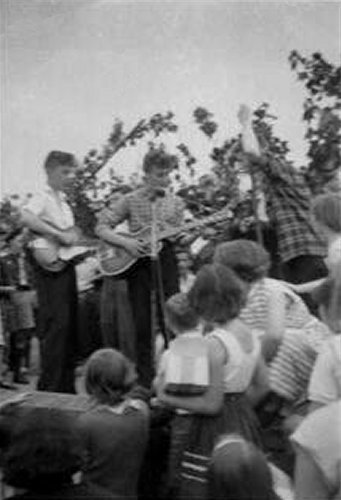
Charlie decided to ask his friend Colin Hanton’s group The Quarrymen to perform in his street in Toxteth; Rosebery Street. The occasion was the 750th anniversary of the founding of Liverpool in 1207. Charlie thought that a skiffle group would add some great fun to the celebrations. Not only did he invite The Quarrymen, but when he borrowed a little camera and took a few photos. These turned out to be the very first photos ever taken of John Lennon performing with The Quarrymen.
The Quarrymen by Charlie Roberts
“At that time,” remarked Charlie, “The Quarrymen would play anywhere for free, because they were doing it for fun. They became more serious after Paul joined, and maybe John was taking it serious, but it was really just friends having some fun. They all turned up, and set themselves up on the back of a wagon that Fred Tyler had brought along. He also wired up a speaker system so that they had something for the microphones, so they made quite a loud noise, which was good.”
The Quarrymen (2) by Charlie Roberts
“I thought they were great, playing good music and entertaining. When you compare them to other bands, I suppose they weren’t that good, but I enjoyed listening to them, and so did the crowd “I can’t remember what songs they played, but it was good fun. The street was decorated with bunting, and we had sandwiches and drinks, and had a good time.”
The Quarry men (3) by Charlie Roberts
John Lennon causing trouble!
“There was an incident involving John, who seemed to upset some of the lads in the crowd. I think he had been winking at some of the girls, and it became obvious that there could be trouble, so as soon as they finished, they grabbed their instruments, and ran into my mum’s house. Some reports have said that the police came and escorted them to the bus stop, but The Quarrymen just stayed in our house for about an hour, and then after everyone had gone, they went home.”
“The party was such a success,” said Charlie, “that the City Council awarded us a prize for the best decorated street, and so the following week we had a second party, with entertainment provided by The Merseysippi Jazz Band, all paid for by the City Council, which was great.”
Charlie followed The Quarrymen to many of the venues they played, like Wilson Hall in Garston, where one particular incident sticks in his memory. “I remember Wilson Hall, when we all had to suddenly run away after the performance. I don’t know who started it or what it was about, but everyone legged it! I was okay, because I hadn’t been performing, so nobody knew me, but the others had to run. The first thing to discard was the tea-chest bass, which was too big and heavy to run with.”
The Quarrymen often went to “Barneys”, the club at St. Barnabas Church Hall. But, like most venues, alcohol was not available. “We used to meet in the Rose of Mossley pub on Rose Lane,” recalled Charlie, “and then we would go on to “Barneys”. We all had to wear proper suits and ties to get in there. After “Barneys” closed, we would then go to the Dutch Café on Smithdown Road, which was open late, one of the few places still open into the early hours of the morning.”
Cement in the Lock!
One of Charlie’s funniest memories takes place in an area called Ford to the north of Liverpool: “The Quarrymen had been booked to play at a party, and so we all travelled up there on the bus as usual. However, the party was in a house, and so there was not much room for the boys to play. By the time they had realised what time it was, the last bus had gone, and so they all decided to stay the night in the house. At some point, John and Paul went out for cigarettes, and there were obviously road works nearby, because they returned with a warning lamp they’d picked up. Everything went quiet, but when we tried to go home, we went to open the door, but somebody had put cement into the door lock! Nobody admitted doing it, but we all had our suspicions, because only John and Paul had been out. So, we all just left through the back door and said nothing.”
Charlie with his Photograph
Charlie also talked about driving around with his friend Arthur Wong.
“Arthur’s dad had a very good business,” Charlie recalled, “and so Arthur had a Vauxhall Cresta PA, a great car with fins, two-tone paint, very much like the American cars. We used to drive around, and I clearly remember John and Paul on the back seat of the car, with Paul trying to master ‘Raunchy’. We had a great time driving around in it with Arthur and we would often end up at Arthur’s home at 42, Heydale Road, in Mossley Hill.”
John Lennon Played in My Road?
And that is where the coincidence comes in! Because, since 1989, I have lived in Heydale Road! And when we moved into this road, Mrs Wong still lived in 42, Heydale Road. As you can see, wherever I go, I am surrounded by The Beatles! A few years ago, I was giving a talk at the Liverpool History Show, and a man came up to me and wanted to see my book, The Fab one hundred and Four: The Evolution of The Beatles. Why? Because he was Arthur Wong’s brother, and told me how he remembered Charlie and friends hanging out with them. Small world this Beatle world isn’t it?
There are more great stories from Charlie in The Fab one hundred and Four, along with those other important people who played a part in Beatles history.