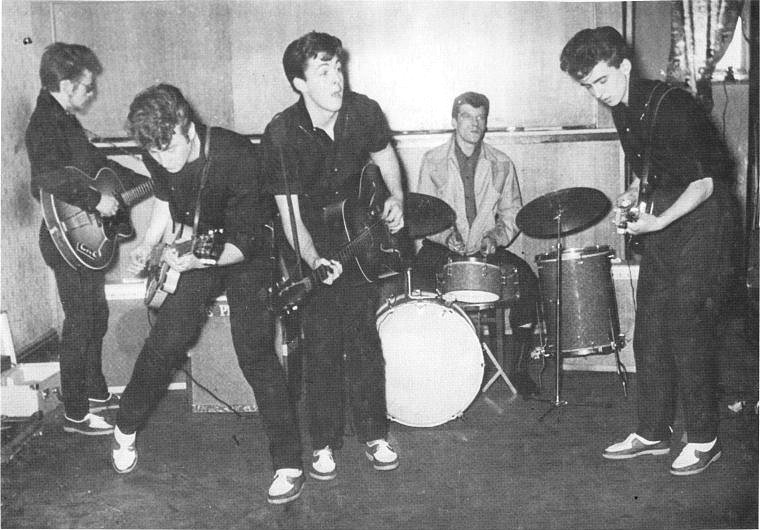
The Quarrymen open the Casbah. George Harrison, Paul McCartney, Ken Brown and John Lennon
1959 is an important year for the group, as, after only a few appearances, they have no more bookings, and George Harrison joins another group, the Les Stewart Quartet. It could have been the end of the road for John, Paul and George, but a twist of fate sees them open The Casbah Coffee Club.
If you want to know the key events in Beatles History, then this is the page for you. This will help you navigate the website, to find the history you need to know. Each link will take you to a different page on the site, where a post, article or interview is located. I will be constantly updating the site, so check back for the latest in Beatles history, discussing Beatles names, Beatles members, Beatles drummers and who the original Beatles were.
15th August 1960 – Pete Best, who joined the previous day, plays his first gig with the now-settled lineup of John, Paul, George, Stuart, and Pete with them called The Beatles.
Ringo, more than any other Beatle, seems to have received criticism over the years for his ability. Is it justified? “Oh, he is just a lucky guy who was in the right place at the right time.” “You could take Ringo out of The Beatles and you would still have The Beatles.”
Finding the Fourth Beatle
When we started work on “Finding the Fourth Beatle“, one of the main aims was to examine why Ringo became the drummer who made the grade with John, Paul and George. Was he just the happy-go-lucky guy who was around at the right time, or was he really a good drummer, or even a great drummer?
What I soon learned was that as a guitarist/keyboardist, I was not qualified to answer that question adequately. I have read so many authors who either compliment or condemn Pete Best or Ringo Starr because they feel like it, without offering any justification, as if their reputation as an author is good enough. Trust me, it isn’t. I have played with plenty of drummers of varying capabilities, and know the difference between a good and bad drummer, but anything more than that is beyond me.
Drummers on Ringo
And so, what we decided to do was to get experienced drummers to examine Ringo’s drumming (we did the same for Pete Best too) and try to work out whether he was just a lucky guy, or really was the influence that many great drummers say he was. And if he is that good, why?
So we rounded up several drummers who could examine Ringo’s style, and get their feedback. It was illuminating. First, I spoke to Gary Astridge, who is Ringo’s drum curator, and been working with him for years. Gary is also a drummer in a band, so he could explain the details behind Ringo’s kits, and how he plays. Second, I spoke to Rob Shanahan, who is Ringo’s photographer, but is also a drummer, with a similar style to Ringo.
A Lefty on a Righty
One of the distinctive sounds created by Ringo is that he is naturally left-handed, but plays on a right-handed kit. Shanahan is also a lefty on a righty, and explains why this creates quite a unique sound, and how Ringo uses his kit. Ringo has also always kept quite a simple kit, and resisted the trend to have lots of tom-toms and other additions to his kit.
“Plays the Song”
One phrase that keeps cropping up is that Ringo “plays the song”, but what does that mean? It took a while to understand it, and I did that with the help of several drummers who play in Beatles tribute bands. They are the ones who have to learn to play Ringo’s parts, and I never realised how difficult that was. Ringo plays by feel, at that moment, and that exact moment in the song, which could be different every time they recorded it.
“Ringo Starr and The Beatles Beat”
Two drummers who are considered experts on Ringo’s drumming are Alex Cain and Terry McCusker. Their incredible book, “Ringo Starr and The Beatles Beat” examines Ringo’s style on every Beatles song, and they shared their expertise with us by analysing 10 of the songs that define Ringo’s style. It is only when you listen to Beatles songs for the drumming that you truly appreciate his contribution to The Beatles’ sound. Just go listen to songs like “Come Together”, “Rain” and “Strawberry Fields Forever”, and you will gain a new appreciation for his talent.
What Alex and Terry also point out is that Ringo, once The Beatles were getting into more complicated musical arrangements, was heavily involved in the arrangement of the song, and contributed not just drum rhythms, but percussion too. He was no ordinary drummer.
Lucky? No!
Although 3 other drummers were offered the chance to join The Beatles to replace Pete Best, it was Ringo who said yes. And that is just as well! Ringo was the perfect drummer for The Beatles at that time, and became an invaluable, and indispensable, member of the Fab Four.
They Found The Fourth Beatle
As you will read in the book, “Finding the Fourth Beatle“, Ringo was, and still is, a great drummer who inspired a whole new generation of drummers who wanted to play like him. Just read the comments from other leading drummers as to how they feel about Ringo. In conjunction with our findings in “Finding the Fourth Beatle“, it is clear that Ringo is respected as a drummer, and not just because he was a Beatle.
When Flora MacDonald in 1746 helped Bonnie Prince Charlie escape from the English to the Isle of Skye, and then to France, little did they know it would help Brian Epstein sign The Beatles! Seriously? Yes! read on.
Bonnie Prince Charlie
My Bonnie Lies Over The Ocean
The Scottish folk song that recorded that story was called “My Bonnie Lies Over The Ocean”. When, in 1961, German Producer Bert Kaempfert decided to make a record with Tony Sheridan, backed by The Beatles (as The Beat Brothers), he wanted a song that the German people would know, but was also performed by the British musicians. He chose “My Bonnie” and “When The Saints Go Marching In”.
“My Bonnie” by Tony Sheridan and The Beat Brothers
Recording “My Bonnie”
Kaempfert combined melody with lush orchestral strings and brass. As well as orchestral and jazz-oriented records, he wrote the music for “Strangers In The Night”, recorded by Frank Sinatra, “Wooden Heart” recorded by Elvis Presley, as well as hits for Nat King Cole and Al Martino. Kaempfert must be one of the few, if not only, to have worked with Elvis, Sinatra and The Beatles.
The Hall Where The Beatles recorded “My Bonnie”
Bert worked for Polydor, who often recorded at a school theatre in Hamburg Harburg. But this was no ordinary theatre, as I found out when I visited there in 2017. Kaempfert had The Beatles and Tony Sheridan, who had been playing this song together at the Top Ten Club, set up on the stage. This is where myth and fact combined to create urban myths!
The Beatles recorded “My Bonnie” on this stage
Some say Kaempfert removed Pete Best’s bass drum and other drums, because he was so bad. This, they claim, became the first of many producers to be dissatisfied with Best’s drumming. There is no evidence for that.
What we do know is that Bert Kaempfert was happy to use The Beatles as a backing band, having seen them several times at the Top Ten Club. We also know that he never used heavy rock ‘n’ roll drums on any track, as he was into Easy Listening music. He therefore asked Pete Best to only use his snare drum and hi-hat cymbal, which he used to great effect, as you can tell when you listen to the record. We have evidence of that. Best’s drumming is superb!
Because there are so many myths, misunderstandings and deliberate mistellings, I was determined in our book, Finding the Fourth Beatle, to ask real drummers what they thought of Pete Best’s drumming on “My Bonnie”. As I said in the book; I am not qualified to offer a professional opinion on drummers, as I am not a drummer, just an author.
Feedback from the drummers
“As Pete Best is not using his bass drum or floor tom, he does a really good job. Maybe Pete at that stage wasn’t experienced or talented enough maybe to play quieter. That is great drumming and a really good, high-speed drum roll in perfect time. How could anyone criticise that?” Mike Rice
“Very tight drum rolls at speed which is hard to do and keep in time. Especially as he didn’t use his full kit, he is very inventive in the use of the snare, with good flicks on the hi-hat, using it like a crash cymbal. A very technical piece of drumming, expertly executed.” Derek and Andrew Hinton
“My Bonnie” and other Songs
What songs were recorded, and in what order, is not known as there is little paperwork completed at the time. It is generally accepted that seven songs were recorded with Kaempfert. On the 22nd June, and possibly on the 23rd June 1961, four songs were committed to tape: “My Bonnie”, plus a German vocal as “Mein Herz Ist Bei Dir”; “The Saints (When The Saints Go Marching In)”; “Why”, written by Sheridan, and “Cry For A Shadow”, George Harrison’s skit on the Shadows, with a virtuoso solo performance, credited to Harrison/ Lennon.
The Beatles were also invited to perform another song, and John chose “Ain’t She Sweet”, one of his favourites, and one that would probably have fitted in with Kaempfert’s desire to record easy listening, old-time songs, that the German listener could identify with. However, what John produced was the harder, rockier sounding vocal performance that they would have done on stage, which didn’t really do him, or the group, justice. There were to be no vocal harmonies that would become their trademark in years to come.
My copy of “My Bonnie” signed by Pete Best
It is also thought that they recorded “Take Out Some Insurance On Me, Baby (If You Love Me, Baby)”, probably at the same sessions, but there isn’t any documentation to confirm this. Sheridan, ably assisted by Paul on bass and Pete on drums also recorded “Nobody’s Child” as well.
This was the Beatles being recorded for the first time as a group, in a studio, with a bona fide producer.
“My Bonnie”, Brian Epstein and The Beatles
To complete the story, Brian Epstein became interested in The Beatles when local fans started asking to order “My Bonnie” by The Beatles. This brought them to Brian’s attention, who, as a record retailer, was interested in a local group who could sell records. (Read the interview with Alistair Taylor for more on that story).
And so, the story that started with Bonnie Prince Charlie’s escape from the English way back in 1746 led to Brian signing The Beatles.
The story of the 23 drummers who put the beat in The Beatles
Finding the Fourth Beatle
Finding the Fourth Beatle: for the first time… ..the Complete Chronicle of the ‘forgotten’ Beatles’ who played their part in the long quest for a drummer.
“They’d had a succession of drummers through the years and finally found one who integrated, someone who fitted. Until this point it was always John, Paul, George … and a drummer…” Neil Aspinall. Former CEO of Apple and the Beatles first road manager
The fourth Beatle to join was Ringo, right? Wrong! How about John, Paul, George and Norman? Or John, Paul, George and Tommy…or Johnny…or Terry? Or even Ronnie the Ted! Ronnie the who? Exactly!
Ringo Starr wasn’t the fourth Beatle to join. He wasn’t even the last! Half a century and hundreds of books after the Beatles went their separate ways, “Finding The Fourth Beatle” has finally pieced together the untold story of the Fab Three’s long quest for a permanent drummer – and how close the problem came to ending their dreams on several occasions, including those of their manager, Brian Epstein!
Thanks to their unrivalled network of sources Liverpool author’s David Bedford and Garry Popper have produced an in-depth investigation into the origins of the Fab Ones themselves, too. As a result “Finding The Fourth Beatle” reads like a thriller, mapping each crisis in the Beatles struggle for fame and fortune. It’s a roller-coaster story that tells it like it really was – a long and winding road paved by ruthless ambition and farce – none more vividly detailed than the panicked conspiracy to dump drummer Pete Best; one of darkest and longest controversies to engulf the band.
Book Highlights
Highlights include: Why Pete Best was not fired/sacked PLUS Those drummers who were almost the “Fourth Beatle”, and those who weren’t In-depth analysis of the failed Decca audition, and EMI sessions in 1962 PLUS why Brian Epstein didn’t sign the first Beatles contract How Ringo Starr joined The Beatles – and who else was asked before him A previously unknown Beatles contract The vindication of Pete Best and a celebration of Ringo Starr
“The must-read Beatles book of the year. A masterwork of rock ’n’ roll sleuthing and good old-fashioned research.” Kenneth Womack, author of Maximum Volume: The Life of Beatles Producer George Martin (The Early Years, 1926-1966)
“This is the work of responsible researchers who challenge the usual received wisdom, carefully presenting their findings on a rock-solid foundation of fact.” Robert Rodriguez, award-winning Beatles author and creator of the Something About The Beatles podcast
Beatles first manager Allan Williams with David Bedford
David grew up in the Dingle, Liverpool, near the bottom of the street, Madryn Street, where Ringo Starr was born. He later attended St. Silas School, the same primary school that Ringo Starr, Billy Fury and Alf Lennon (John’s father).
He and his wife, Alix, moved to live near Penny Lane, where they have lived for the last 30 years. Their three daughters were born in Oxford Street Maternity Hospital, where John Lennon has been born. The three girls all attended Dovedale School, the same school that John Lennon and George Harrison attended. David had been the Chair of Governors there for nearly 20 years.
When illness forced him to retire at the age of 35, encouraged by his doctor, he began to read, research and write about The Beatles for the London Beatles Fan Club magazine, and helped to found the British Beatles Fan Club. Realising that so many stories about The Beatles and Liverpool were incorrect, he set out to dispel the myths by interviewing the people who knew The Beatles best.
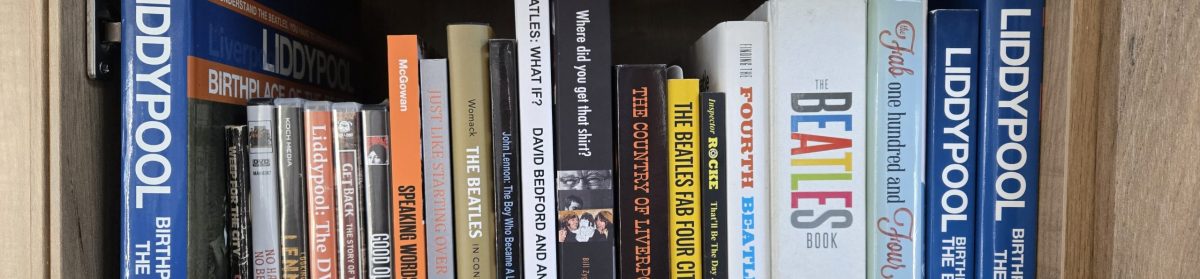
The Fab one hundred and Four: The Evolution of The Beatles
The Fab one Hundred and Four
His second book, the follow-up to “Liddypool”, “The Fab one hundred and four: The Evolution of The Beatles” was published in 2013 to further critical acclaim, with original interviews and rewriting Beatles history, by telling of the 104 people who contributed to the early history of The Beatles.
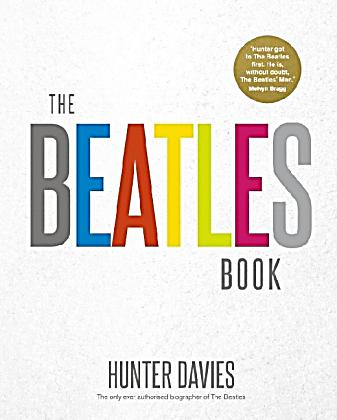
The Beatles Book
The Beatles Book
In 2016, he published a book with original Beatles biographer Hunter Davies, plus Spencer Leigh and Keith Badman, called “The Beatles Book”.
Inspector Rocke: That’ll Be The Day That I Die
As an aside from his Beatles books, David wrote a crime fiction novel in 2017 around a fictional Liverpool detective called Inspector Rocke. Each story is set around a key moment in Beatles history, and features The Beatles themselves, though not as suspects!
Looking for Lennon
In 2018, he was the Associate Producer and Historian for the documentary feature film “Looking for Lennon”, which was nominated for a National Film Award.
Finding the Fourth Beatle
Finding the Fourth Beatle
In 2018, he also published his third book, with co-author Garry Popper, called “Finding the Fourth Beatle“, about the 23 drummers who put the beat in The Beatles.
He has several other book projects, and much more, on the go.
For the first time, the country music roots of The Beatles are covered in detail, telling how Liverpool had the biggest Country and Western scene in the UK – and probably in Europe – in the 1940s, ‘50s and ‘60s. This influenced The Quarrymen and, of course, The Beatles.
The Beatles: What If?
The Beatles: What If?
IN 2025, David published his latest book, The Beatles: What If?, written with his friend Andrew Phillips.
They have looked at 70 key moments in Beatles history, where if something had changed, Beatles history could have worked out differently.
What if Ivan Vaughan hadn’t been friends with both John and Paul?
What if The Beatles passed the audition at Decca?
What if they didn’t meet Brian Epstein?
These and many more are examined, and their potential affect on Beatles history is discussed. But will you agree?
David was the Archive Producer/ Historian for the documentary film, No Hamburg, No Beatles, about The Beatles story in Hamburg. featuring rare archive and photos, together with interviews, this is the definitive story of The Beatles apprenticeship in the clubs of Hamburg.
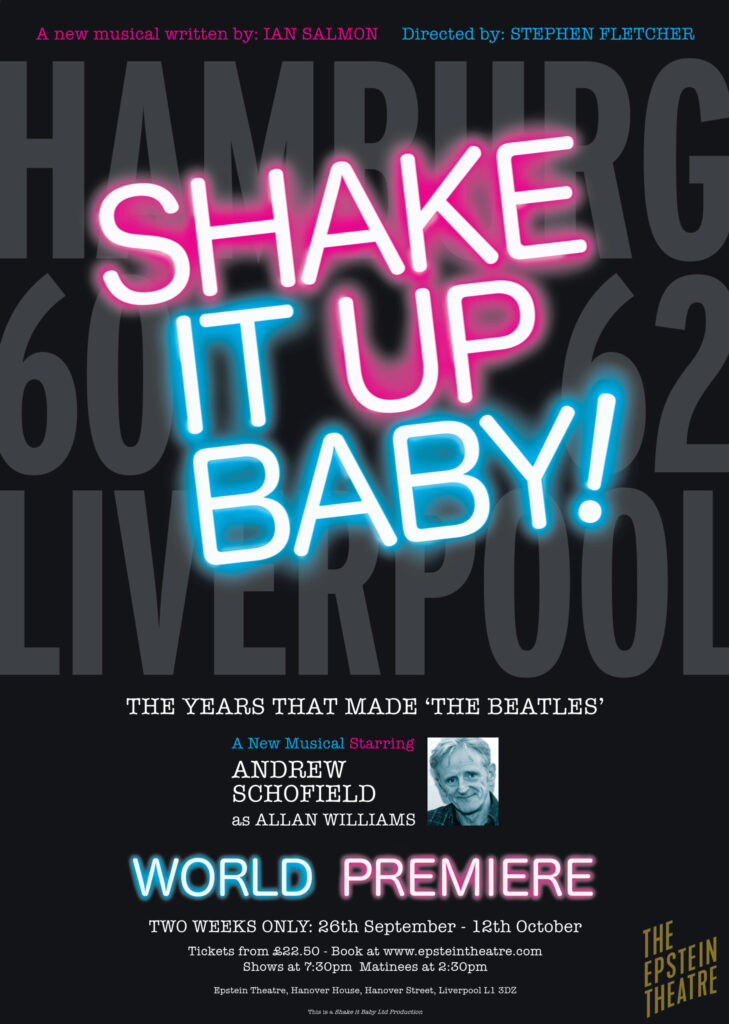
Shake It Up Baby!
David was the Script Advisor/ Historian for this play written by Ian Salmon and Directed by Stephen Fletcher. It had its premiere in Liverpool at the Epstein Theatre in September 2025.
John, Paul, George and Mahapurush? Sound familiar?
Well, it happened, and the full story is in “Finding the Fourth Beatle” – not long now to reserve your limited edition copy of the new book that is rewriting Beatles history. Mahapurush is only 1 of the 22 drummers featured in the book. Can you count 22 drummers? If not, you need this book! Finding the Fourth Beatle
On Pete Best’s 76th birthday, Pete is probably the most controversial person in Beatles history, who divides opinions. Was he a good drummer? Why did the Beatles get rid of him? When we began work on “Finding the Fourth Beatle”, we realised we had to address these questions and reach an objective conclusion, and it has been one of the most interesting, and controversial investigations we have ever undertaken. There is so much invested in urban myth and opinion that reaching the truth is never easy.
However, what we have been able to prove is that Pete Best was never sacked! We have evidence, and I interviewed Brian Epstein’s lawyer who explained what really happened in that meeting at NEMS, and why Pete was not sacked.
We have also enlisted the help of 9 drummers to analyse Pete and Ringo’s drumming, especially the Decca audition, EMI audition and those first visits to Abbey Road in September 1962.
That way, we will have independent, objective analysis. After all, you can’t take the word of an author who isn’t a drummer, can you?
David Bedford Pre-Order your copy now