1960 in Beatles History: The year that made The Beatles. Many Beatles drummers, lots of different Beatles names, Allan Williams is the Beatles manager and they go to Hamburg

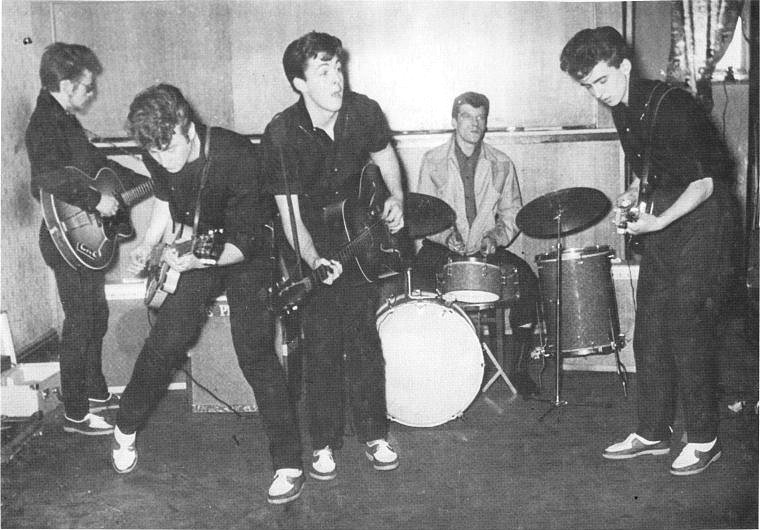
The Silver Beatles, John Lennon, Paul McCartney, George Harrison, Stuart Sutcliffe with Johnny "Hutch" Hutchinson
The Silver Beatles

January 1960 – The Beatals

January 1960 – Stuart Sutcliffe joins the group

23rd April 1960 – The Nerk Twins: John and Paul

5th May 1960 – Allan Williams becomes The Beatles manager

May 1960 – The Black Roots of The Beatles

10th May 1960 – The Silver Beatles audition for Larry Parnes with Johnny Hutchinson

10th May 1960 – The Silver Beatles audition for Larry Parnes with Tommy Moore

14th May 1960 – The Silver Beats and Cliff Roberts

20th May 1960 – Johnny Gentle and His Group

June 1960 – The Beatles back Janice “The Stripper”

14th June 1960 – John, Paul, George, Stuart and Ronnie the “Ted”

14th June 1960 – An Undertaker dies on Stage: Jackie Lomax

18th June 1960 – John, Paul, George, Stuart and Norman Chapman

24th June 1960 – Royston Ellis: The Man on the Flaming Pie

July 1960 – The Silver Beetles at the Embassy Club

12th August 1960 – The Unknown Drummer

12th August 1960 – Pete Best is asked to join The Beatles

15th October 1960 – John, Paul, George and Ringo appear on a record for the first time

17th December 1960 – Chas Newby joins The Beatles

27th December 1960 – The Beatles, Beatlemania at Litherland Town Hall

1959 in Beatles History: The Quarrymen open The Casbah Coffee Club

The Quarrymen open the Casbah
The Quarrymen open the Casbah. George Harrison, Paul McCartney, Ken Brown and John Lennon

1959 is an important year for the group, as, after only a few appearances, they have no more bookings, and George Harrison joins another group, the Les Stewart Quartet. It could have been the end of the road for John, Paul and George, but a twist of fate sees them open The Casbah Coffee Club.

29th August 1959 – The Quarrymen open The Casbah

26th October 1959 – Johnny and the Moondogs

December 1959 – Rod Murray and Stuart Sutcliffe are invited to join the group

1957 in Beatles History: John meets Paul, and George joins The Quarry Men

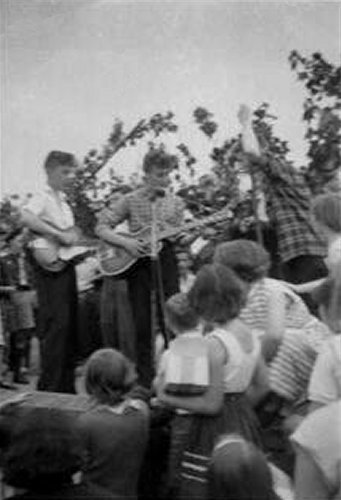
The Quarrymen at St. Peter's Church on 6th July 1957
The Quarrymen at St. Peter’s Church on 6th July 1957

Spring 1957 – The Blackjacks?

22nd June 1957 – Charlie Roberts photographs The Quarry Men at Rosebery Street

6th July 1957 – Paul McCartney is introduced to John Lennon at St. Peter’s Garden Fete – Part 1

6th July 1957 – Paul McCartney is introduced to John Lennon at St. Peter’s Garden Fete – Part 2

6th July 1957 – Paul McCartney is introduced to John Lennon at St. Peter’s Garden Fete – Part 3

6th July 1957 – First published photographs of The Quarrymen parade

August 1957 – The McCartney brothers

18th October 1957 – Paul McCartney’s debut with The Quarrymen; or is it?

7th December 1957 – George Harrison joins The Quarry Men

1956 in Beatles History: The Quary Men are formed

Bill Smith, Pete Shotton and John Lennon
Bill Smith, Pete Shotton and John Lennon at Quarry Bank School

Rock Island Line is Released

April 1956: Michael Hill introduces John Lennon to the music of Little Richard

Spring 1956 – Arthur Pendleton teaches John to play Harmonica

Summer 1956 – Geoff Lee (also known as George Lee) suggests to John Lennon that he form a skiffle group

Summer 1956 – John, Pete and Bill Smith and the theft of a tea-chest bass

October 1956 – The Quarry Men’s first performance

Beatles History

If you want to know the key events in Beatles History, then this is the page for you. This will help you navigate the website, to find the history you need to know. Each link will take you to a different page on the site, where a post, article or interview is located. I will be constantly updating the site, so check back for the latest in Beatles history, discussing Beatles names, Beatles members, Beatles drummers and who the original Beatles were.

The information is from my three books: “Liddypool: Birthplace of The Beatles”, “The Fab one hundred and Four: The Evolution of The Beatles” and “Finding the Fourth Beatle”.

To make it easier to find, there is a separate page for each year. Select the page year to find out what happened in Beatles history that year.

1956 – John Lennon forms The Quarrymen

1957 – John and Paul meet, and George joins The Quarrymen

1958 – The Quarry Men make a record; An off-duty policeman kills Julia, John Lennon’s mother

1959 – The Quarrymen open The Casbah Coffee Club

1960 – The year that made The Beatles. Many Beatles drummers, lots of different Beatles names, Allan Williams is the Beatles manager and they go to Hamburg

15th August 1960 – Pete Best, who joined the previous day, plays his first gig with the now-settled lineup of John, Paul, George, Stuart, and Pete with them called The Beatles.

1961 – The Beatles are the best group; Brian Epstein discovers The Beatles at The Cavern Club

1962 – The Beatles attend the Decca audition; George Martin signs The Beatles. Find out why Pete Best was NOT sacked/ dismissed from The Beatles. Ringo Starr joins The Beatles. The Fab Four release “Love Me Do”, their first single.

David's Social Media
David’s Social Media

15th July 1958: Julia Lennon is knocked down and killed

John Lennon with his mother, Julia
A young John Lennon with his mother, Julia

Just three days after making their first record at Percy Phillips’ studio in Kensington, Liverpool, tragedy was to strike John Lennon once more.

In the June of 1955, his Uncle George had died suddenly. The 14-year-old John took it badly. However, what did help him was the re-establishing of a relationship with his mother, Julia. She had bought him his first guitar, taught him to play a few songs using banjo chords and even let The Quarrymen rehearse in her house. She encouraged his love of music.

“I Lost her Twice”

On 15th July 1958, he was to lose his mother for the second time; this time it was forever. Having been taken away from his mother at the age of five, he longed for a relationship with her again in his teens. When making “Looking for Lennon”, our documentary feature film, we interviewed and filmed Nigel Walley, John’s childhood friend and eyewitness to Julia’s death.

Julia often used to take the bus to Mendips to see her sister Mimi, and on this occasion, John was in his mother’s house. Nigel called at Mendips just as Julia was coming out of Mendips, and walked to the corner of Vale Road with her. After saying goodnight, Nigel headed down Vale Road to his house, while Julia crossed the road and headed for the bus stop. As she crossed the old tram tracks and stepped onto the road, a car, driven by an off-duty policeman who didn’t have a full driving license, slammed on its brakes, but it was too late: the car hit Julia and sent her flying through the air. Nigel heard the brakes and turned round to see his best friend’s mother in the air and slamming onto the road. He ran over, but he knew she was dead. He can still picture her red hair blowing in the wind.

John opened the door…..

John answered the door of his mother’s house to the police, exactly like it is in the movies he said. He was devastated. The mother he adored was gone, and he spent the rest of his life seeking something for fill the void left by her. He immortalised her in song “Julia”. Some would say he never recovered from her loss.

Instant Karma

The policeman, Eric Clague, eventually left the police force and, in a strange twist of “instant karma”, became a postman, delivering Beatles fan mail to 20, Forthlin Road, the McCartney house.

Looking for Lennon

You can see the footage we shot with Nigel Walley, and the affect it had on him according to those who knew him best, and they didn’t all agree on how it affected John, in Looking for Lennon.

It is available on digital download worldwide on various platforms, on DVD/Blu-Ray in the US and will be sold all round the world. It should be out on DVD/Blu-ray in the UK soon, and is still available to watch on SkyTV.

Find out more here

David Bedford

12th July 1958: John, Paul and George make their first record

Why Percy Phillips got there before George Martin did

Percy Phillips Record by The Quarrymen
The First record made by John, Paul and George
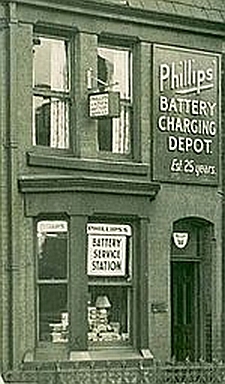
Percy Phillips Studio
Percy Phillips’ Studio was in the back room of his house

This small studio tucked inside a Victorian terraced house at number
38, Kensington is where The Quarrymen made their first and only
demo record. It was a disc that eventually became one of the most
historic recordings in popular music. John, Paul, George, Colin
Hanton and John Duff Lowe paid seventeen shillings and sixpence
(87.5 pence) and cut a two-sided disk made of shellac. They couldn’t
afford to pay for a tape and so the recording was made straight to
disk.

McCartney/ Harrison Song

The five-piece ensemble recorded Buddy Holly’s “That’ll Be
The Day” and “In Spite Of All The Danger”, an original McCartney-
Harrison tune. It was seen as Paul’s song with George providing
the guitar solo.

Percy Phillips in his studio
Percy Phillips (right) in his studio

Percy Phillips owned the studio, which was on the ground floor.
His clients waited in the front parlour and recorded in the back room
studio. The studio consisted of two tape-recorders, a microphone
hanging from the ceiling, a piano and disc-cutter, which produced
these shellac discs.

Interview with Colin Hanton

Colin Hanton spoke about that famous first recording. “We met at a theatre and walked up there. All I remember was this back room with electronic equipment in the corner. We set up our equipment with me in the corner and the lads with their guitars: there were no amps, it was all-acoustic. John Lowe was over by the wall on the piano. I was hitting the drums and he said that they were too loud, so I tried again but there was still the same problem, which was finally fixed by putting a scarf over the snare to soften it and keep it as quiet as possible.

Colin Hanton of The Quarrymen

“John Duff Lowe reckons there was one microphone hanging down from the ceiling, which picked everything up. He was complaining because he said we should get the tape, which was a pound, but we just had enough each— three shillings and sixpence (17.5 pence). I always felt that was one of the reasons to invite John Lowe along to split it five ways. John and Paul went white at the thought of a pound. “Percy was fed up because we were taking too much time, and starting to look at the clock. ‘In Spite Of All The Danger’ was quite long, and he said to chop a verse off. John said no. John Lowe could see Phillips from where he was sitting and he was apparently telling John to finish. We kept going, so the record ended with the song going almost to the centre of the disc, right to the hole in the middle.

We had a record!

In Spite of all the Danger
In Spite of all the Danger by The Quarrymen

“He gave us the disc and off we went. It was a big thing. How many people had records like popular crooner, Matt Monro? So we had a record too, and could listen to ourselves. We had heard our group before because the girl who lived next door to me, Geraldine Davies, had a Grundig tape recorder. She’d record us and then we’d all sit down and listen to it. It was a momentous day for us. I can still remember it so clearly”.
The songs appeared on Anthology Disc 1.

This interview first appeared in “Liddypool“. Read the full interview in the book – get your copy here.

Liddypool
Liddypool by David Bedford

David Bedford

10th July 1964: The Beatles Civic reception at Liddypool Town Hall

Original Cover of Liddypool

On 10th July 1964, The Beatles arrived in Liverpool for a civic reception at Liverpool’s Town Hall, as well as holding the Northern Premiere of A Hard Day’s Night. The image of them standing on the balcony was so iconic, I decided it should grace the cover of my first book “Liddypool: Birthplace of The Beatles“, published in 2009.

The reception was difficult to arrange, but Brian was determined to make it happen. His letter explained it:

“Thank you very much for your charming letter of the 4th instant. As you
probably know the boys and I set forth for the United States tomorrow morning. On their return the boys have an intense filming schedule, which will take them up to the end of April. They will then be resting for most of the month of May. So therefore while I look forward very much to accepting your kind invitation, for which the boys and I are most appreciative, I think the actual date may have to be left in abeyance for the present. With many thanks and best wishes.
Yours respectfully,
Brian Epstein

On the flight home their thoughts were occupied with this visit to Liverpool. One of the travelling journalists who had accompanied the group down under was from the Liverpool Daily Post and Echo, named, ironically, George Harrison—no relation whatsoever. Harrison’s observation was astute: “Probably for the first time in their show-biz lives our world-famed troubadours are nervous. They aren’t sure how their fellow citizens will react to this home-coming triumph. The four boys are thrilled to their fringes at the honour Liverpool is bestowing upon them. But in the back of their mind is a niggling doubt”.

Harrison spoke to each of The Beatles about how they were feeling as they came closer to their return to Liverpool. Even though all the preparations had been made, Paul McCartney didn’t know if it would click with Liverpool people. “I can’t somehow see all the kids I used to go to school with from Mather Avenue and their parents, turning out to watch young Paul McCartney drive by in a big car, along the road where we used to play together. I don’t think I’d bother to go and cheer for somebody else”, McCartney said honestly, “and I’ve got a feeling that they won’t do it for us either.

“And who is going to stand outside the Town Hall just to see us arrive? Only a couple of years back hardly anybody in Liverpool had heard of us. Now this! I’m keeping my fingers crossed and hoping that everything comes off all right, but I have butterflies in my tummy over it”.

Harrison (the reporter) observed that the manner of The Beatles was one of humility and that “there still isn’t a big head among the four of them. They just can’t believe they are important”.

John Lennon, never normally short of words, could hardly explain how he felt about the forthcoming event. “The only time I’ve ever been at the Town Hall was when they sent me from art school to draw it. Going back like this, in state, or whatever they call it, is a bit scary”. Ringo, however, was more forthcoming. “It’s a funny feeling. Makes you feel small and yet ten feet tall. I mean, all those other places in Australia and New Zealand where we went to civic receptions, they were only parties of people we didn’t know, like. But this is different”, Ringo enthused. “It’s Liverpool. Think of being in that parade from Speke to the Town Hall with some of our old mates probably looking at us and saying; ‘I knew that lot when they were poor’. And that wasn’t so long ago either, was it?” he said with a smile.

Even the “quiet” Beatle had an opinion. George spoke to his namesake with his own perspective. “It’s great that our own home town should do this for us”, he said seriously, “but deep down I have the feeling that there are a lot of Liverpool folk who deserve this honour far more than we do. After all”, he continued modestly, “what have we done? Sang some songs around the place and made money. It doesn’t seem much compared with some things
that have been done by many Liverpool men and women who’ve never been honoured”.

Fab one hundred and Four
The Fab one hundred and Four

The above is taken from my first book “Liddypool“. Little did I know when Liddypool was published what would happen next. Now in its third edition, it has sold over 5,000 copies worldwide, and led to me publishing two further books, “The Fab one hundred and Four: The Evolution of The Beatles” and “Finding the Fourth Beatle“, plus co-authoring “The Beatles Book” with Beatles biographer Hunter Davies. Last year, the first documentary I have consulted on was released; “Looking for Lennon”. I have visited the US a dozen times at various Beatles conventions, and been a guest at other events in Europe, and have several other projects on the go which keeps me in mischief!

Liddypool
Liddypool by David Bedford

Everywhere I go in Liverpool, I see so many Beatles tour guides using “Liddypool” to help give tours to their visitors. I am so privileged, and cannot thank everyone enough for your support.

I love what I do; it is a labour of love. I just want to share my amazing city of Liverpool, and why it was crucial in the evolution of The Beatles; they could not have come from any other city.

You can get your copy of “Liddypool” now.

Welcome to Liddypool: Birthplace of The Beatles.

David Bedford

Happy Birthday Ringo – The Fourth Beatle

Was Ringo just LUCKY or A BRILLIANT DRUMMER?

Finding the Fourth Beatle

Ringo, more than any other Beatle, seems to have received criticism over the years for his ability. Is it justified? “Oh, he is just a lucky guy who was in the right place at the right time.” “You could take Ringo out of The Beatles and you would still have The Beatles.”

Finding the Fourth Beatle

When we started work on “Finding the Fourth Beatle“, one of the main aims was to examine why Ringo became the drummer who made the grade with John, Paul and George. Was he just the happy-go-lucky guy who was around at the right time, or was he really a good drummer, or even a great drummer?

What I soon learned was that as a guitarist/keyboardist, I was not qualified to answer that question adequately. I have read so many authors who either compliment or condemn Pete Best or Ringo Starr because they feel like it, without offering any justification, as if their reputation as an author is good enough. Trust me, it isn’t. I have played with plenty of drummers of varying capabilities, and know the difference between a good and bad drummer, but anything more than that is beyond me.

Drummers on Ringo

And so, what we decided to do was to get experienced drummers to examine Ringo’s drumming (we did the same for Pete Best too) and try to work out whether he was just a lucky guy, or really was the influence that many great drummers say he was. And if he is that good, why?

So we rounded up several drummers who could examine Ringo’s style, and get their feedback. It was illuminating. First, I spoke to Gary Astridge, who is Ringo’s drum curator, and been working with him for years. Gary is also a drummer in a band, so he could explain the details behind Ringo’s kits, and how he plays. Second, I spoke to Rob Shanahan, who is Ringo’s photographer, but is also a drummer, with a similar style to Ringo.

A Lefty on a Righty

One of the distinctive sounds created by Ringo is that he is naturally left-handed, but plays on a right-handed kit. Shanahan is also a lefty on a righty, and explains why this creates quite a unique sound, and how Ringo uses his kit. Ringo has also always kept quite a simple kit, and resisted the trend to have lots of tom-toms and other additions to his kit.

“Plays the Song”

One phrase that keeps cropping up is that Ringo “plays the song”, but what does that mean? It took a while to understand it, and I did that with the help of several drummers who play in Beatles tribute bands. They are the ones who have to learn to play Ringo’s parts, and I never realised how difficult that was. Ringo plays by feel, at that moment, and that exact moment in the song, which could be different every time they recorded it.

“Ringo Starr and The Beatles Beat”

Two drummers who are considered experts on Ringo’s drumming are Alex Cain and Terry McCusker. Their incredible book, “Ringo Starr and The Beatles Beat” examines Ringo’s style on every Beatles song, and they shared their expertise with us by analysing 10 of the songs that define Ringo’s style. It is only when you listen to Beatles songs for the drumming that you truly appreciate his contribution to The Beatles’ sound. Just go listen to songs like “Come Together”, “Rain” and “Strawberry Fields Forever”, and you will gain a new appreciation for his talent.

What Alex and Terry also point out is that Ringo, once The Beatles were getting into more complicated musical arrangements, was heavily involved in the arrangement of the song, and contributed not just drum rhythms, but percussion too. He was no ordinary drummer.

Lucky? No!

Although 3 other drummers were offered the chance to join The Beatles to replace Pete Best, it was Ringo who said yes. And that is just as well! Ringo was the perfect drummer for The Beatles at that time, and became an invaluable, and indispensable, member of the Fab Four.

They Found The Fourth Beatle

As you will read in the book, “Finding the Fourth Beatle“, Ringo was, and still is, a great drummer who inspired a whole new generation of drummers who wanted to play like him. Just read the comments from other leading drummers as to how they feel about Ringo. In conjunction with our findings in “Finding the Fourth Beatle“, it is clear that Ringo is respected as a drummer, and not just because he was a Beatle.

Happy birthday Ringo, the Fourth Beatle.

To get your copy of “Finding the Fourth Beatle“, order on Amazon or via our website

David Bedford

To purchase David's books, go to CLICK HERE
RSS
Follow by Email
Instagram