Beatles History Blog

Ronnie The “Ted” is revealed!

Ronnie the "Ted" is revealed
Ronnie the “Ted” is revealed

On one evening in June 1960 at the Grosvenor Ballroom, Wallasey, Ronnie, the leader of a Teddy Boy gang, got up on stage with The Silver Beatles; John Lennon, Paul McCartney, George Harrison and Stuart Sutcliffe. He sat in the drummer’s seat, and hit the drums, as drummer Tommy Moore had not turned up. John Lennon asked if there was a drummer in the building, and Ronnie got up on the stage and played drums all night. He was terrible, but those Beatles were too afraid to say anything.

Thankfully, their manager Allan Williams managed to get them out of the awkward situation, and they escaped to live another day! Williams told Ronnie that if they didn’t find another drummer by the following week, then he would call him. Naturally, Williams never made the call!

For years, I have been searching for the identity of Ronnie the “Ted”, and finally, I discovered, with the help of my friend Peter Hodgson, to reveal the true identity of Ronnie the “Ted”.

Read the full story, in “Finding the Fourth Beatle“.

David Bedford

You can find out more about the book on this website – “Finding the Fourth Beatle”

The Beatles at the Barnston Women’s Institute

On 25th September 1962, The Beatles returned to my favourite venue; the Barnston Womens Institute on the Wirral. They first appeared at this tiny venue in March with Pete Best in their new suits, and now they were back this time with Ringo. Its a small hall attached to a farm, and you could only get between 80-100 people in there! Rock n roll!! #beatles #liddypool

Happy birthday Brian Epstein: Build a Statue

Brian Epstein, manager of The Beatles

On 19th September 1934, Brian Epstein was born in Liverpool. Without him, The Beatles would not have made it out of Liverpool. However, he still doesn’t get the credit he deserves. Celebrate the “Fifth Beatle”, Brian Epstein, today and every day.

Brian’s Birth

Brian was born at 4, Rodney Street, Liverpool, in a private nursing home on 19th September 1934. This building was the former home of the first US Consul, James Maury.

In our new book, Finding the Fourth Beatle, read our interview with David Harris, Brian’s lawyer. He helped us understand the man who became the Beatles manager, and why he was a man of his word.

Brian Epstein with "his boys" The Beatles
Brian Epstein with “his boys” The Beatles

Brian’s Legacy

Brian’s legacy is in taking the leather-clad rock ‘n’ rollers out of The Cavern Club and onto the world stage. His knowledge and love of the theatre was essential in making the Fab Four the greatest pop group ever. He taught them stop eating, drinking, smoking and swearing on stage; to be more professional, to bow at the end of their performance, and to make them commercially acceptable to the entertainment world in London.

It was only through his record contacts through his business, NEMS, that got them in front of Decca on 1st January 1962, and ultimately to an audition with George Martin on 6th June 1962, which led to a record contract. Brian got them onto BBC Radio in March 1962, and even had them sign a management contract with him, which he didn’t sign. David Harris explained why, because Brian, above all things, was a decent and fair man, and he wanted The Beatles to be able to walk away from him if he failed to do what he promised.

Although he saw the conquer the world, his tragic death in August 1967 meant that he never witnessed the legacy he had helped to create.

A Statue for Brian

Liverpool is trying to erect a statue to Brian Epstein, and we need the help of Beatles fans worldwide. He deserves it, in Liverpool, for all that he did.

David Bedford

www.thefourthbeatle.com
#brianepstein #fifthbeatle #beatles #fourthbeatle @fifthbeatle @fourthbeatle

Andy White – Love Me Do


What an interesting day 11th September 1962 was for The Beatles. Not satisfied with Ringo’s drumming the previous week, George Martin did what he told Brian Epstein back in June. He was going to use a session drummer on their first record. Ringo walked into the studio and was shocked to see another drummer setting up. It was Andy White. Read my interview with Andy about his recollection of the session, and also why Ringo thought they were “doing a Pete Best on me.”
Ringo was also confused as to which record he was on – the single or the LP. We compare the two versions released, with both Ringo and Andy White’s drumming analysed by drummers and experts. Ringo didn’t forgive George Martin for years – if at all. For Ringo, he wouldn’t be needing session drummers to replace him once he established himself as the Fourth Beatle.
Andy White is one of our 23 drummers in Finding the Fourth Beatle
Https://www.thefourthbeatle.com
#ringo #ringostarr #beatles #beatle #fourthbeatle

7th September 1962: The Beatles at Irby Village Hall

The Beatles: Paul McCartney, George Harrison, John Lennon and Ringo Starr

In this little hall on 7th September 1962, in between The Beatles two EMI sessions on 4th September and 11th September, John, Paul, George and Ringo played here at Irby Village Hall on the Wirral. Although the hall was packed, they hadn’t raised enough money to pay Brian Epstein, who had to return for the balance of the money.

George Harrison’s forgotten suitcase

George Harrison also left a suitcase behind, full of guitar strings and those bits and bobs of electrical gear. George never collected it. How quickly their world changed from here. Only 15 months later, they were appearing before over 70 million Americans on the Ed Sullivan Show. They earned their success.

Irby Village Hall

From this photograph, you can see that it wouldn’t hold that many people. Irby Village Hall is one of over 100 local venues featured in Liddypool, my first book.

David Bedford

4th September 1962 EMI

4th September 1962 was an interesting day for The Beatles, and shrouded in confusion too. Ringo had joined just a couple of weeks before, and they found themselves at Abbey Road. Was this a recording session? A catch-up? Why was there no session drummer? From alleged phone calls to the confusion over which version of “Love Me Do” was later released (Ringo was convinced he didn’t play on the single), we pick our way through the mists of time and clarify what really happened that day, in Finding the Fourth Beatle. It’s about more than just the 23 drummers!
Find out more at www.thefourthbeatle.com

John, Paul, George and Mahapurush

John, Paul, George and Mahapurush? Sound familiar?
Well, it happened, and the full story is in “Finding the Fourth Beatle” – not long now to reserve your limited edition copy of the new book that is rewriting Beatles history. Mahapurush is only 1 of the 22 drummers featured in the book. Can you count 22 drummers? If not, you need this book!
Finding the Fourth Beatle

“There Goes The Knighthood!” said Ringo Starr

When Ringo recorded “Elizabeth Reigns” on his Ringo Rama album (2003), he signed off by saying; “there goes the knighthood”.  Some of his lyrics were not overly complimentary to her majesty, like:
We don’t really need a king.
Six hundred servants
Use her detergent
Scrubbing the palace floor
 
And all of your sins are
As big as the Windsors
So let’s point our fingers
No more.”
Has that delayed his knighthood? Does he even deserve one?
Many have questioned: “why has he got it?” or “just because he was a Beatle?”. “Is this just further degrading the honour system?”
So what has Ringo done to deserve it? Many people, including Beatles fans, don’t give Ringo the credit for his part in The Beatles’ success. Was he just a lucky guy who jumped on the bandwagon, or something more?
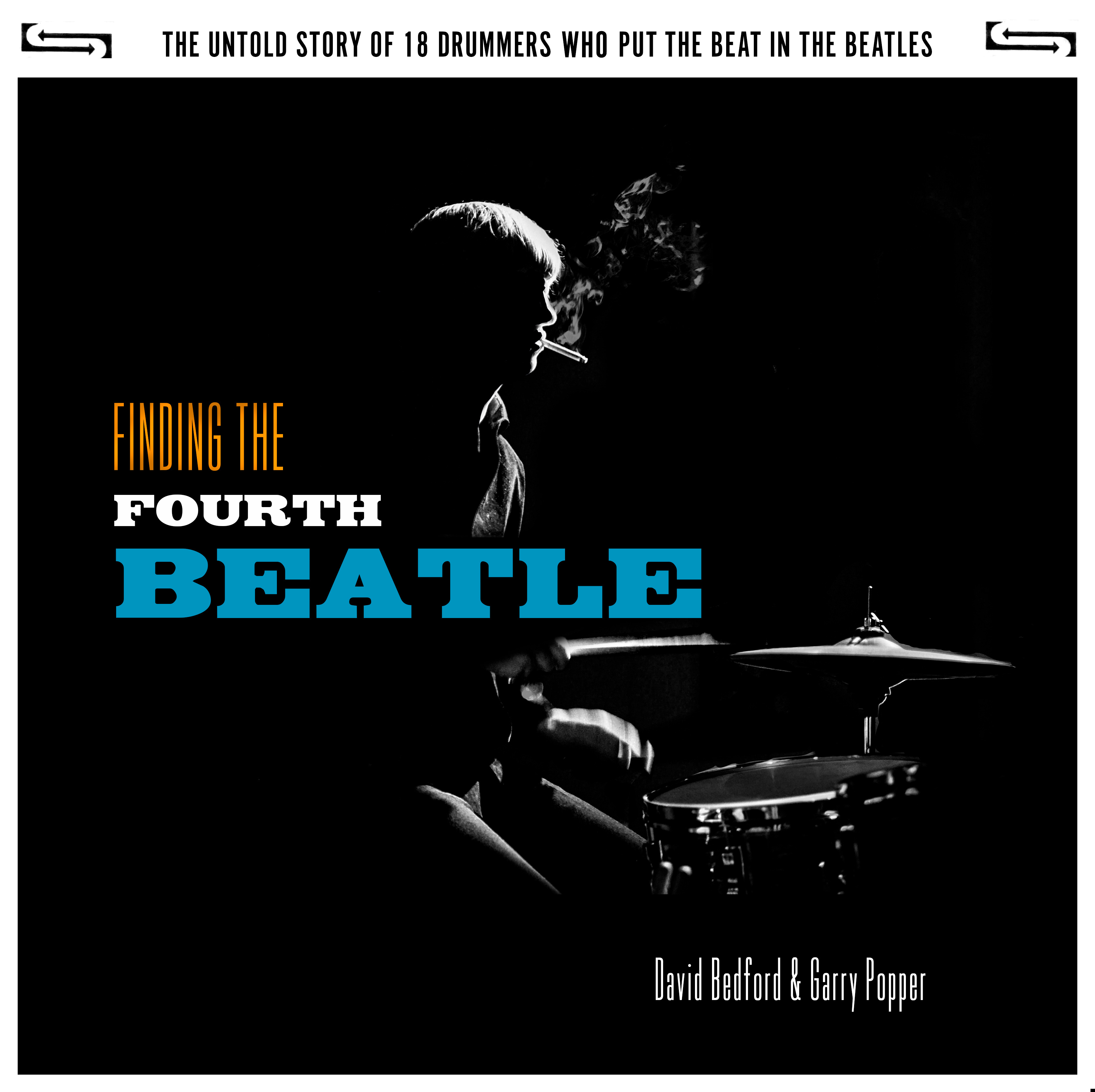
FLAT_Fourth-Beatle_GBF_SkellettIn our new book, “Finding the Fourth Beatle”, we examine how and why Ringo became the drummer in the Fab Four, the only drummer to have lasted the distance with John, Paul and George. From 1956-1970, we detail the 18 drummers who played a part in their success, and ultimately why Ringo became the right drummer at the right time. He wasn’t the first drummer asked to replace Pete Best, but he proved to be a wise choice.

But we aren’t just saying it without backing it up with evidence. We have enlisted the help of several drummers who explain what it was that made Ringo such a unique drummer, by analysing his style and his experience of playing skiffle, country, jazz, and to the audiences in summer camps at Butlins. We have had a number of Beatles songs analysed, and show his contribution, what difference he did make to those songs, and the evolution of The Beatles’ sound. He wasn’t just a spare part sat at the back of the band, but integral to their development as a group, who has gone on to be recognised as one of the most influential drummers of all time. Not bad for a boy from the Dingle!
But that, in itself, isn’t enough to warrant a knighthood. What else has he done? His well-known problems with alcohol led him, and his second wife Barbara Bach, to check in to rehab to battle alcoholism. Ringo emerged as a new man, and together with Barbara, the two established the Lotus Foundation:
“The objectives of the Lotus Foundation are to fund, support, participate in and promote charitable projects aimed at advancing social welfare in diverse areas including, but not limited to:

  • Substance abuse
  • Cerebral palsy
  • Brain tumours
  • Cancer
  • Battered women and their children
  • Homelessness
  • Animals in need”

Over the years, he has raised millions of pounds for his charity through books, performances, and most recently by selling off property and memorabilia he no longer needs/ uses. Through his high-profile status as a former Beatle, and successful solo artist, he has made a difference to countless lives around the world, much of which goes on unnoticed.
You don’t get a knighthood for being a Beatle: you do for making a difference and promoting Peace and Love.
Arise, Sir Fourth Beatle Ringo (and don’t mention “Elizabeth Reigns”!)
David Bedford
Pre-order “Finding the Fourth Beatle” now
 

Happy Birthday Pete Best

On Pete Best’s 76th birthday, Pete is probably the most controversial person in Beatles history, who divides opinions. Was he a good drummer? Why did the Beatles get rid of him? When we began work on “Finding the Fourth Beatle”, we realised we had to address these questions and reach an objective conclusion, and it has been one of the most interesting, and controversial investigations we have ever undertaken. There is so much invested in urban myth and opinion that reaching the truth is never easy.
However, what we have been able to prove is that Pete Best was never sacked! We have evidence, and I interviewed Brian Epstein’s lawyer who explained what really happened in that meeting at NEMS, and why Pete was not sacked.
We have also enlisted the help of 9 drummers to analyse Pete and Ringo’s drumming, especially the Decca audition, EMI audition and those first visits to Abbey Road in September 1962.
That way, we will have independent, objective analysis. After all, you can’t take the word of an author who isn’t a drummer, can you?
David Bedford
Pre-Order your copy now

Obscure “Sgt. Pepper” People, with Liverpool Connections

 
“Carl Jung” – Liverpool is the pool of life. “I FOUND myself in a dirty, sooty city. It was night, and winter, and dark, and raining. I was in Liverpool.” But Carl Gustav Jung, the man who famously concluded that “Liverpool is the pool of life” – never was.
Carl Gustav Jung 26 July 1875 – 6 June 1961) was a Swiss psychiatrist and the founder of analytical psychology, who worked with Sigmund Freud.
“Fred Astaire” – Fred and Ginger, Alf and Julia. Alf “Fred” Lennon and Julia “Ginger” Stanley both loved dancing and were the Fred and Ginger of Liverpool!
“Sir Robert Peel” – A two-time Prime Minister of Great Britain, Sir Robert Peel was a major force behind easing restrictions on Catholics in Britain and the reformation of the judicial system in the 1830s. He was later considered to be an enemy to his own Conservative party when he went against his own political interest to repeal the Corn Laws to help alleviate the effects of the Irish Famine in the 1840s. John Lennon’s great-grandparents came over from Ireland in the 1840s so this would have helped the Lennon family.
“Tommy Handley” – Liverpool comedian. Thomas Reginald “Tommy” Handley (17 January 1892 – 9 January 1949) was a British comedian, mainly known for the BBC radio program ITMA (“It’s That Man Again”). He was born at Toxteth Park (where John’s parents Alf Lennon and Julia Stanley were from), Liverpool in Lancashire. The Beatles would have listened to Tommy Handley on the radio, one of many Liverpool comedians, like Ted Ray, Arthur Askey, and Rob Wilton.
“Albert Stubbins” – from Newcastle. One of the best centre-forwards of his generation, in the 1940s, he moved from Newcastle to Liverpool FC for £13,000 in 1946. Liverpool’s rivals, Everton FC also tried to sign him, so he decided on the toss of a coin between Liverpool and Everton. Liverpool won! Why would he be there, as none of The Beatles were particularly sporty? When John was at Dovedale School, around the age of seven, he wrote a paper called “Sport and Speed, Illustrated”. This would have been the time when Stubbins was scoring regularly for Liverpool FC. Maybe that is why he appears on the cover.
“Anonymous Legionnaire: RAOB” – Hiding behind actress Diana Dors is a member of the Royal Antediluvian Order of Buffaloes. The fraternal organization, which started in 1822, raises money for charities and provides assistance to its members and their families in times of need. This isn’t a random selection. John’s uncles, Charlie and Herbert Lennon, were members of The Dingle Lodge 4303, which was situated at 36, Devonshire Road, just two doors away from my childhood home of 40, Devonshire Road.
To find out more about The Beatles and Liverpool, you can order the brand new Third Edition of “Liddypool: Birthplace of The Beatles” from www.davidabedford.com
David Bedford

To purchase David's books, go to CLICK HERE
RSS
Follow by Email
Instagram